Radical Technologies
OTHER
★★★★★
(2,095 ratings)  50,000+ Student

ISO/IEC 27001:2022 LEAD AUDITOR

ISO/IEC 27001:2022 Lead Auditor Training is a 24-hour, practical and job-oriented course designed to develop the skills required to plan, conduct, report, and follow up on Information Security Management System (ISMS) audits. Learners will understand ISO/IEC 27001:2022 requirements, audit planning, risk and control assessment, audit evidence, nonconformity reporting, corrective actions, and audit team leadership. Ideal for information security professionals, auditors, consultants, compliance professionals, IT managers, and professionals involved in ISMS implementation or auditing.

RT
Radical Technologies
50,000+ English 24 Hours Weekdays / Weekends Classroom / Online / Corporate
Online / Classroom

ISO/IEC 27001:2022 LEAD AUDITOR

IT Training Programme

Duration 24 Hours
Batch Type Weekdays / Weekends
Mode of Training Classroom / Online / Corporate
Locations Pune, Bangalore, Kochi
Language English
Certification Globally Recognized
Call Now

100% placement assistance

Enquire Now

Get course fees, batch dates & a callback

We never share your details.

What you'll learn

Understand core concepts and architecture from the ground up
Get hands-on with the tools used by working professionals
Build real-world projects you can add to your portfolio
Learn industry best practices and coding standards
Practice with real datasets and real-world scenarios
Prepare for certification and technical interviews
Work on collaborative, team-based exercises
Apply performance tuning and optimization techniques
Understand how the technology fits into a larger ecosystem
Complete assignments reviewed by mentors

Programme Overview

22 sections covering the complete curriculum — a single, progressive learning arc.

24 Hours
Training Duration
22
Core Modules
542
Total Lessons
4.6★
Average Rating
50K+
Students Trained
01

Foundations & Core Concepts

Get hands-on with the fundamentals and architecture — the building blocks for everything that follows.

Fundamentals Architecture Setup
02

Hands-On Practical Training

Work through real exercises and assignments designed to mirror what you will do on the job.

Practicals Assignments Labs
03

Real-World Projects

Apply what you have learned to end-to-end projects that go straight into your portfolio.

Projects Portfolio Case Studies
04

Advanced Techniques

Go beyond the basics with advanced concepts, integrations and production-grade practices.

Advanced Integration Best Practices
05

Ecosystem Integration

Understand how this technology connects with the broader tools and platforms used in the industry.

Ecosystem Tools Platforms
06

Performance & Interview Prep

Master optimization techniques and prepare for the technical interview questions employers actually ask.

Optimization Interview Prep Certification

Who is this programme for?

Whether you're already writing code, working with data, or supporting applications today — this programme is built to take you into a OTHER role.

Software Developers

Engineers who want to add this skill set to their toolkit

Analysts & Consultants

Professionals moving into a more technical, hands-on role

IT Professionals

System admins and support engineers upskilling into a new domain

Fresh Graduates

CS/IT graduates aiming for a job-ready technical role

Course Curriculum

22 sections  •  542 lessons  •  24 Hours

01 Course Overview

This course is designed to develop the knowledge and practical skills required to plan, conduct, report, and follow up first-party, second-party, and third-party audits of an Information Security Management System. Participants will learn how to evaluate an organization’s ISMS against ISO/IEC 27001:2022 requirements, assess information security risks and controls, identify audit evidence, document nonconformities, prepare audit reports, and lead an audit team.

02 Prerequisites

Participants should have:

Basic knowledge of information security
Understanding of management-system concepts
Familiarity with the Plan–Do–Check–Act cycle
Basic awareness of risk management
Knowledge of organizational processes and documentation
Basic understanding of ISO/IEC 27001 requirements is recommended
Experience in IT, cybersecurity, compliance, quality, risk, or internal auditing is beneficial
03 Module 1: Information Security and ISMS Fundamentals

Topics Covered

Information security concepts
Confidentiality, Integrity, and Availability
Information assets and asset ownership
Information security threats and vulnerabilities
Information security risks and impacts
Information security objectives
Introduction to Information Security Management Systems
Benefits of implementing an ISMS
ISMS lifecycle
Plan–Do–Check–Act model
Risk-based thinking
Management commitment and continual improvement
Relationship between information security, business continuity, privacy, and compliance

Practical Exercise

Identify information assets in a sample organization
Prepare a basic information security risk scenario
Map business objectives to information security objectives
04 Module 2: ISO/IEC 27001:2022 Standard Requirements

Clause 4: Context of the Organization

Understanding the organization and its context
Internal and external issues
Interested parties and their requirements
Determining the scope of the ISMS
Establishing and maintaining the ISMS
Scope exclusions and their justification
Understanding business processes and information flows

Clause 5: Leadership

Leadership and commitment
Information security policy
Roles, responsibilities, and authorities
Top management responsibilities
Information security governance
Management accountability

Clause 6: Planning

Actions to address risks and opportunities
Information security risk assessment
Information security risk treatment
Risk acceptance criteria
Risk owners
Information security objectives
Planning changes to the ISMS

Clause 7: Support

Resources
Competence
Awareness
Communication
Documented information
Document creation and updating
Document control
Evidence of competence and awareness

Clause 8: Operation

Operational planning and control
Information security risk assessment execution
Information security risk treatment implementation
Change management
Outsourced processes
Operational evidence

Clause 9: Performance Evaluation

Monitoring and measurement
Analysis and evaluation
Internal audit
Audit-program management
Management review
Management review inputs and outputs
Performance indicators and audit evidence

Clause 10: Improvement

Continual improvement
Nonconformity
Corrective action
Root-cause analysis
Effectiveness verification
Improvement records

Practical Exercise

Interpret ISO/IEC 27001 clauses using sample organizational evidence
Identify conformity and nonconformity
Prepare a clause-to-evidence mapping document
05 Module 3: Annex A Information Security Controls

Overview of Annex A

Purpose of Annex A
Relationship between risk assessment and control selection
Statement of Applicability
Control applicability and justification
Control ownership
Control implementation evidence
Control monitoring and review

Organizational Controls

Policies for information security
Information security roles and responsibilities
Segregation of duties
Management responsibilities
Contact with authorities and interest groups
Threat intelligence
Information security in project management
Inventory of information and associated assets
Acceptable use of information assets
Return of assets
Classification and labelling of information
Information transfer
Access control
Supplier relationships
Cloud-service security
Incident management
Business continuity
Legal, statutory, regulatory, and contractual requirements

People Controls

Screening
Terms and conditions of employment
Security awareness and training
Disciplinary process
Responsibilities after termination or change of employment
Remote working
Event reporting

Physical Controls

Physical security perimeters
Entry controls
Securing offices and facilities
Monitoring physical security
Protection against physical and environmental threats
Working in secure areas
Clear desk and clear screen
Equipment protection
Secure disposal and reuse of equipment

Technological Controls

User endpoint devices
Privileged access rights
Information access restriction
Secure authentication
Capacity management
Malware protection
Vulnerability management
Configuration management
Data deletion
Data masking
Data leakage prevention
Backup
Logging and monitoring
Clock synchronization
Network security
Cryptography
Secure development lifecycle
Application security requirements
Secure coding
Development and test environments
Change management
Test information
Audit testing and assurance

Practical Exercise

Review a sample Statement of Applicability
Match risks to applicable controls
Identify missing control implementation evidence
Prepare audit questions for selected Annex A controls
06 Module 4: Audit Principles and Auditor Competence

Topics Covered

Purpose and objectives of an ISMS audit
Audit principles
Integrity
Fair presentation
Due professional care
Confidentiality
Independence
Evidence-based approach
Risk-based approach
Auditor responsibilities
Lead Auditor responsibilities
Audit-team competence
Auditor behavior and communication
Maintaining objectivity
Managing conflicts of interest
Sampling and professional judgment
Audit trails and working papers

Auditor Competencies

Technical knowledge
Audit knowledge
Interviewing skills
Observation skills
Analytical skills
Report-writing skills
Conflict management
Time management
Decision-making
Leadership and team coordination

Practical Exercise

Auditor role-play
Interviewing process owners
Evaluating audit evidence
Handling disagreement during an audit
07 Module 5: Audit Programme and Audit Initiation

Topics Covered

Establishing an audit programme
Audit programme objectives
Audit scope and criteria
Audit frequency
Audit methods
Audit resources
Audit risks and opportunities
Audit-team selection
Auditor independence
Audit-team responsibilities
Contacting the auditee
Confirming audit feasibility
Preparing the audit terms of reference
Confidentiality and security arrangements
Audit timetable and logistics

Audit Types

First-party audit
Internal audit
Second-party audit
Supplier audit
Third-party certification audit
Surveillance audit
Recertification audit
Follow-up audit
Remote audit
Hybrid audit

Practical Exercise

Create an annual ISMS audit programme
Prepare an audit initiation checklist
Select an audit team based on competence and independence
08 Module 6: Audit Preparation and Planning

Topics Covered

Defining audit objectives
Establishing audit scope
Establishing audit criteria
Understanding the auditee’s organization
Reviewing ISMS documentation
Reviewing the ISMS scope
Reviewing the risk assessment methodology
Reviewing the risk treatment plan
Reviewing the Statement of Applicability
Reviewing previous audit reports
Identifying significant risks
Preparing an audit plan
Preparing an audit timetable
Preparing audit checklists
Preparing interview questions
Determining audit sampling
Planning remote-audit activities
Allocating responsibilities to audit-team members

Audit Documents

Audit programme
Audit plan
Audit checklist
Audit notification
Document-review checklist
Audit evidence record
Nonconformity report
Audit report
Corrective-action follow-up record

Practical Exercise

Prepare a complete ISO 27001 audit plan
Develop a clause-based audit checklist
Prepare interview questions for IT, HR, facilities, and management
09 Module 7: Conducting the ISMS Audit

Opening Meeting

Introduction of the audit team
Confirmation of objectives, scope, and criteria
Confirmation of audit methods
Communication channels
Safety, security, and confidentiality requirements
Audit timetable
Availability of guides and escorts
Handling changes to the audit plan

Audit Evidence Collection

Interviews
Observation
Document review
Record review
Technical verification
Sampling
Cross-checking evidence
Reviewing system-generated logs
Testing control implementation
Tracing evidence from policy to practice
Confirming objective evidence

Auditing Techniques

Open-ended questions
Closed questions
Clarifying questions
Follow-up questions
Process-based auditing
Risk-based auditing
Sampling techniques
Evidence triangulation
Remote interviewing
Auditing outsourced and cloud services

Areas for Audit Verification

ISMS scope
Information security policy
Risk assessment
Risk treatment
Statement of Applicability
Access management
Incident management
Backup and recovery
Supplier security
Security awareness
Vulnerability management
Logging and monitoring
Business continuity
Internal audit
Management review
Corrective actions

Practical Exercise

Conduct a simulated opening meeting
Interview process owners
Collect and classify audit evidence
Prepare audit notes and working papers
10 Module 8: Audit Findings and Nonconformity Management

Topics Covered

Conformity and nonconformity
Major nonconformity
Minor nonconformity
Observation
Opportunity for improvement
Positive findings
Audit evidence supporting a finding
Statement of requirement
Statement of objective evidence
Statement of the nonconformity
Risk and impact of nonconformity
Avoiding vague findings
Avoiding unsupported conclusions
Root-cause analysis
Corrective-action requirements
Corrective-action verification

Common ISO 27001 Audit Findings

ISMS scope does not reflect actual business operations
Risk assessment methodology is not consistently applied
Risk owners are not clearly assigned
Statement of Applicability lacks justification
Access reviews are not performed as planned
Security awareness records are incomplete
Supplier security reviews are not documented
Backup restoration tests are not performed
Vulnerability remediation is overdue
Internal audit programme is incomplete
Management review records lack required inputs
Corrective actions are not verified for effectiveness

Practical Exercise

Write major and minor nonconformity reports
Distinguish observation from nonconformity
Review sample corrective-action plans
Verify corrective-action effectiveness
11 Module 9: Audit Reporting and Closing the Audit

Topics Covered

Preparing audit conclusions
Audit-report structure
Executive summary
Audit objectives, scope, and criteria
Audit-team details
Audit dates and locations
Summary of audit activities
Positive findings
Nonconformities
Opportunities for improvement
Audit conclusions
Unresolved issues
Restrictions and limitations
Distribution and confidentiality
Conducting the closing meeting
Presenting findings professionally
Handling disagreements
Obtaining acknowledgement of findings
Issuing the final audit report

Practical Exercise

Prepare a complete ISMS audit report
Conduct a closing meeting
Present findings to senior management
Respond to auditee questions
12 Module 10: Audit Follow-Up and Certification Process

Topics Covered

Corrective-action review
Corrective-action acceptance
Root-cause evaluation
Action-plan review
Evidence review
Effectiveness verification
Follow-up audit
Closure of nonconformities
Escalation of overdue actions
Audit-programme improvement
Certification audit stages
Stage 1 audit
Stage 2 audit
Surveillance audits
Recertification audits
Certification decision process
Auditor competence and continual development

Practical Exercise

Review a corrective-action plan
Verify evidence submitted by an auditee
Prepare a follow-up audit report
Conduct a certification-readiness review
13 Hands-On Labs and Workshops
ISMS Scope Definition Workshop
Information Asset Identification Lab
Information Security Risk Assessment Lab
Risk Treatment Plan Preparation Lab
Statement of Applicability Review Lab
ISO/IEC 27001 Clause Interpretation Workshop
Annex A Control Mapping Lab
ISMS Document Review Exercise
Audit Programme Preparation Lab
Audit Plan Development Lab
Audit Checklist Preparation Lab
Auditor Interview Skills Workshop
Evidence Collection and Sampling Lab
Access Control Audit Simulation
Incident Management Audit Simulation
Supplier Security Audit Simulation
Backup and Business Continuity Audit Simulation
Nonconformity Writing Workshop
Corrective-Action Verification Lab
Complete ISMS Audit Simulation
14 Assignments
Prepare an ISMS scope statement
Create an information asset register
Develop a basic risk assessment
Prepare a risk treatment plan
Review a Statement of Applicability
Map ISO/IEC 27001 clauses to audit evidence
Prepare an Annex A control checklist
Develop an annual audit programme
Prepare a five-day audit plan
Create an audit interview questionnaire
Evaluate sample audit evidence
Write three audit findings
Prepare a corrective-action request
Review a sample audit report
Develop an audit follow-up plan
15 Mini Projects

Mini Project 1: ISMS Readiness Assessment

Assess a sample organization against ISO/IEC 27001:2022 requirements and prepare a readiness-gap report.

Mini Project 2: Supplier Security Audit

Audit a cloud or IT service provider using supplier security requirements and documented evidence.

Mini Project 3: Internal ISMS Audit

Plan and conduct an internal audit covering risk management, access control, incident management, and documented information.

Mini Project 4: Annex A Control Effectiveness Review

Evaluate selected Annex A controls and identify implementation gaps.
16 Capstone Project

Enterprise ISO/IEC 27001:2022 Certification Readiness Audit

Participants will perform a complete simulated audit for an organization preparing for ISO/IEC 27001 certification.

Capstone Activities

Understand the organization and business context
Define audit objectives, scope, and criteria
Review ISMS documentation
Examine the risk assessment process
Review the Statement of Applicability
Prepare an audit programme and audit plan
Conduct opening meeting
Interview process owners
Collect objective evidence
Audit selected Annex A controls
Identify and classify findings
Prepare nonconformity reports
Conduct closing meeting
Prepare the final audit report
Review corrective-action plans
Conduct follow-up verification
Present audit conclusions to management

Capstone Deliverables

Audit programme
Audit plan
Audit checklist
Evidence collection records
Audit working papers
Nonconformity reports
Corrective-action review
Final audit report
Management presentation
17 Real-Time Job-Oriented Scenarios
Auditing an organization’s ISMS scope after a business expansion
Reviewing access-control evidence for privileged users
Auditing employee onboarding and offboarding
Verifying periodic access reviews
Reviewing backup policies and restoration-test records
Auditing cloud-service provider security controls
Checking vulnerability-management records
Reviewing security incident response evidence
Auditing security awareness and training records
Verifying supplier risk assessments
Reviewing business continuity and disaster recovery tests
Auditing encryption and key-management processes
Checking logging and monitoring controls
Reviewing internal audit and management review records
Evaluating corrective actions from a previous audit
Preparing an organization for Stage 1 certification audit
Supporting a Stage 2 certification audit
Conducting a surveillance-audit follow-up
18 Troubleshooting and Audit Challenges
Auditee provides incomplete evidence
Documents do not match actual practices
Risk assessment does not cover critical assets
Statement of Applicability lacks adequate justification
Control ownership is unclear
Process owner disagrees with an audit finding
Audit evidence is insufficient to support a conclusion
Different departments provide conflicting information
Audit scope is too broad for the available time
Remote audit access is unavailable
Logs are missing or overwritten
Corrective actions address symptoms rather than root causes
Nonconformities are not closed within the agreed timeframe
Auditor independence is challenged
Confidential information is exposed during evidence collection
19 Industry Tools and Templates

Governance and Compliance Tools

ServiceNow GRC
RSA Archer
MetricStream
OneTrust
AuditBoard
IBM OpenPages
Microsoft Purview Compliance Manager

Security and Monitoring Tools

Microsoft Sentinel
Splunk
IBM QRadar
Elastic Security
Microsoft Defender
Nessus
Qualys
Tenable
CrowdStrike

Documentation and Collaboration Tools

Microsoft Word
Microsoft Excel
Microsoft SharePoint
Microsoft Teams
Confluence
Jira
Google Workspace

Audit Templates

ISMS scope template
Risk register
Risk treatment plan
Statement of Applicability
Audit programme
Audit plan
Audit checklist
Interview questionnaire
Evidence register
Nonconformity report
Corrective-action tracker
Audit report
Follow-up audit report
20 Best Practices
Audit against documented criteria and objective evidence
Maintain independence and impartiality
Use a risk-based audit approach
Avoid assumptions and unsupported conclusions
Record evidence accurately
Ask process-focused questions
Validate findings with the auditee
Protect confidential information
Maintain complete audit trails
Link every finding to a requirement and evidence
Distinguish nonconformity from observation
Focus corrective actions on root causes
Verify corrective-action effectiveness
Maintain auditor competence
Use sampling consistently
Communicate findings clearly and professionally
21 Certification Preparation
The course can include preparation for relevant auditor examinations and certification pathways, depending on the selected certification provider.

Possible certification pathways include:

CQI/IRCA ISO/IEC 27001:2022 Lead Auditor
PECB ISO/IEC 27001 Lead Auditor
Exemplar Global ISO/IEC 27001 Auditor
NBQP-registered ISMS Lead Auditor training
ISO/IEC 27001 Internal Auditor certification

Certification eligibility, examination format, experience requirements, and auditorregistration requirements vary by provider. A training certificate alone does not automatically confer certification as an internationally registered lead auditor.

22 Mock Interviews and Assessment

Technical Questions

Explain the purpose of an ISMS.
What is the difference between ISO/IEC 27001 and ISO/IEC 27002?
Explain the purpose of the Statement of Applicability.
How do you audit risk assessment and risk treatment?
What is the difference between major and minor nonconformity?
How do you collect objective audit evidence?
What are the responsibilities of a Lead Auditor?
Explain first-party, second-party, and third-party audits.
How do you verify corrective-action effectiveness?
What is the role of ISO 19011 in ISMS auditing?

Practical Assessments

Audit-plan preparation
Audit-checklist development
Interview simulation
Evidence evaluation
Nonconformity writing
Closing-meeting presentation
Audit-report preparation
Corrective-action verification
Final written examination

Expected Learning Outcomes

After completing the course, participants should be able to:

Explain ISO/IEC 27001:2022 requirements
Understand Annex A control objectives and implementation evidence
Plan an ISMS audit
Prepare audit checklists and audit schedules
Conduct interviews and collect objective evidence
Evaluate conformity and nonconformity
Prepare audit findings and reports
Lead audit meetings
Review corrective actions
Conduct audit follow-up activities
Support internal, supplier, and certification-readiness audits

Tools & Technologies

Every tool listed here is installed, configured and used in a hands-on lab session.

Core Tools

Hands-On Labs

Practical Environment

Industry-Standard Tools

Real-World Setup

Guided Exercises

Skill Building

Sample Datasets

Practice Material

Practice & Projects

Mini Projects

Applied Practice

Assignments

Mentor Reviewed

Doubt Sessions

Live Support

Career Readiness

Resume Building

Career Support

Mock Interviews

Interview Prep

Certification Prep

Global Recognition

Deployment & Delivery

Production Practices

Real-World Ready

Best Practices

Industry Standards

542+
Hands-On Lessons
22
Core Modules
24 Hours
Training Duration
100%
Practical Training

You don't just learn ISO/IEC 27001:2022 LEAD AUDITOR. You ship it.

Three major projects, each mirroring how production teams actually work — from guided foundations to a portfolio-ready capstone.

PROJECT // 01

Guided Foundation Project

→Requirement Analysis

→Guided Implementation

→Mentor Review

→Iteration

Foundation Beginner

Apply the fundamentals in a structured, mentor-reviewed project

Take the core concepts from the first half of the curriculum and apply them to a realistic scenario, with guidance and feedback from your mentor at every step.

Structured project brief
Step-by-step implementation
Mentor feedback and review
Documented outcome
Stack Core Concepts Best Practices
PROJECT // 02

Applied Practice Project

→Scenario Design

→Independent Build

→Testing & Validation

→Peer Review

Applied Intermediate

Build a more independent project mirroring real production scenarios

Work through a project that combines multiple concepts from the curriculum, closer to how work is actually structured on the job — less hand-holding, more ownership.

End-to-end implementation
Testing and validation
Documentation
Peer/mentor review
Stack Applied Skills Testing
PROJECT // 03

Capstone Project

→Planning

→End-to-End Build

→Review & Refinement

→Presentation

Capstone Advanced

Take a project from requirements to a polished, portfolio-ready deliverable

Your final project — plan, build, test and present a complete solution using everything covered in the curriculum, reviewed by mentors before you graduate.

Complete working solution
Presentation-ready documentation
Mentor sign-off
Portfolio-ready deliverable
Stack Full Curriculum Portfolio

All 3 projects go directly into your portfolio & resume — reviewed by mentors before you graduate.

See Sample Project Reports

Upcoming Batches

No upcoming batches scheduled right now. Enquire to get notified.

Why Radical Technologies

Live Online Training
  • Highly practical oriented training
  • Installation support on your system
  • 24/7 Email and Phone support
  • 100% Placement Assistance
  • Global Certification Preparation
  • Trainer-Student Interactive Portal
  • Assignments and Projects by Mentors
Live Classroom Training
  • Weekend / Weekdays / Morning / Evening batches
  • 80:20 Practical and Theory ratio
  • Real-life Case Studies
  • Easy make-up for missed sessions
  • PSI | Kryterion | Redhat Test Centers
  • Lifetime Video Classroom Access (coming soon)
  • Resume Prep and Mock Interviews
Self-Paced Training
  • Learn 300+ courses at your own time
  • 50,000+ Satisfied Learners
  • Course Completion Certificate
  • Practical Labs available
  • Mentor Support available
  • Doubt Clearing Session available
  • 10% Discounted Global Certification

Like the Curriculum? Let's Get Started

Join 50,000+ students already enrolled at Radical Technologies

Enroll Now

Global Certification

Radical Technologies is the leading IT certification institute in Pune, offering globally recognized certifications across various domains. With expert trainers and comprehensive materials, we ensure students gain in-depth knowledge and hands-on experience to excel in their careers. Our certification programs are tailored to meet industry standards — from cloud technologies to data science — empowering individuals to stay ahead in the ever-evolving tech landscape.
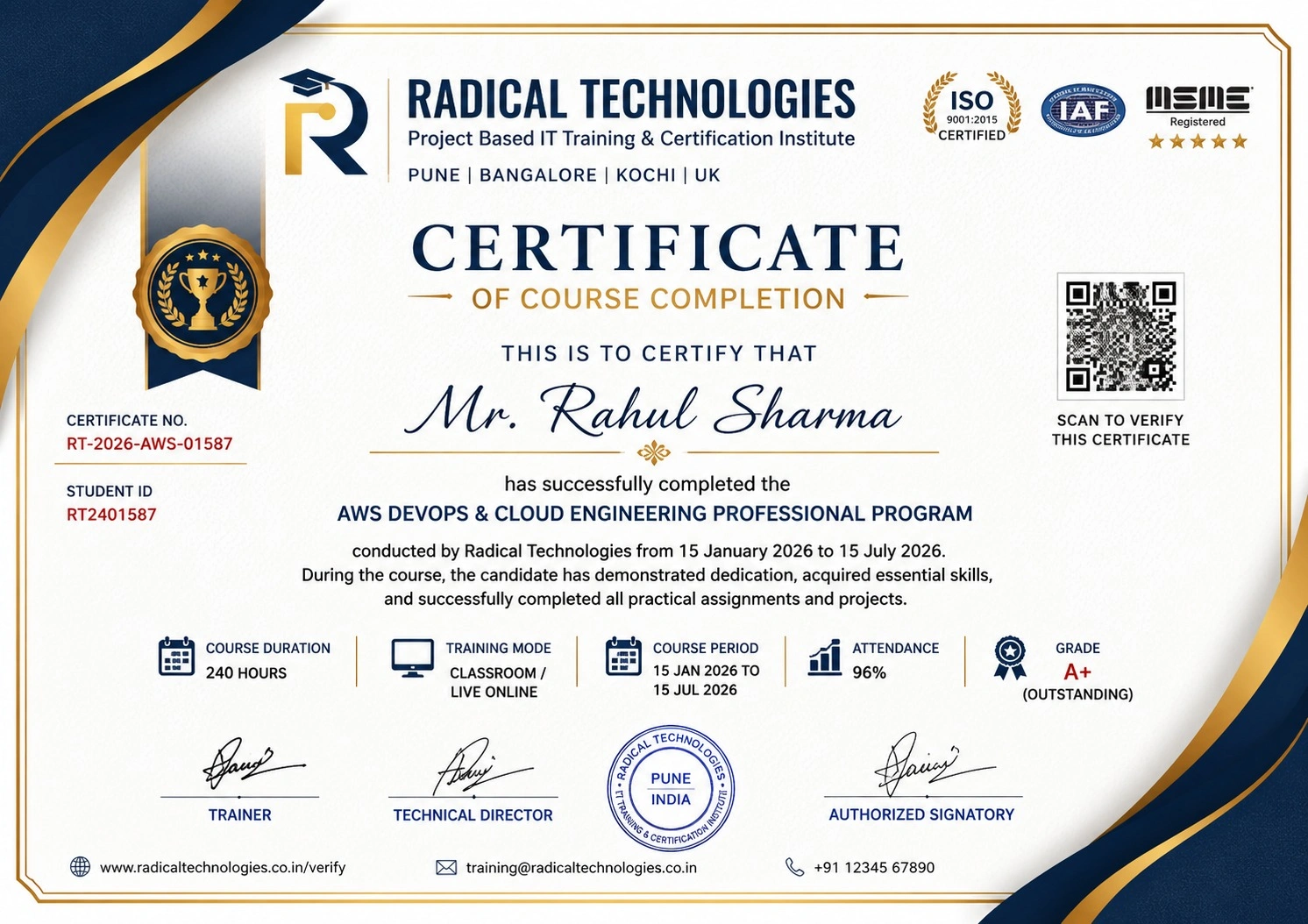
Certificate of Completion

Career Services

At Radical Technologies, we are committed to your success beyond the classroom. Our 100% Job Assistance program ensures that you are not only equipped with industry-relevant skills but also guided through the job placement process. With personalised resume building, interview preparation, and access to our extensive network of hiring partners, we help you take the next step confidently into your IT career.

Career Support

Course Completed? Need next steps?
Need Interview Supports?
Need Job Assistance?
Came from any other Institute?

Join our Brush-up Session & get support until you find a job!

Get Started

Radical Learning Eco-System

Exam Simulator

Cloud SandBox

Hands-on Cloud Lab

Developer Coding Ground

Student Reviews

4.6★
Average learner rating
50K+
Students trained
30+
Hiring companies alumni work at
100%
Placement assistance
4.6
★★★★★

Course Rating

★★★★★
73%
★★★★☆
19%
★★★☆☆
5%
★★☆☆☆
2%
★☆☆☆☆
1%

ISO/IEC 27001:2022 Lead Auditor Course Certification with Online Training in Pune [UPDATED]

ISO/IEC 27001:2022 Lead Auditor Training is a 24-hour, practical and job-oriented course designed to develop the skills required to plan, conduct, report, and follow up on Information Security Management System (ISMS) audits. Learners will understand ISO/IEC 27001:2022 requirements, audit planning, risk and control assessment, audit evidence, nonconformity reporting, corrective actions, and audit team leadership. Ideal for information security professionals, auditors, consultants, compliance professionals, IT managers, and professionals involved in ISMS implementation or auditing.

Our Alumni Work At

Accenture
Amazon
Avisys Services
Birlasoft
Capgemini
Catchpoint
Cognizant
Darwish Cybertech
DataVision
GiBots
Google
Groots Software
HCL Technologies
IBM
Info Gain
Infosys
ITCube Solutions
KPIT
L&T Infotech
Microsoft
Mphasis
mPhatek
Oracle
Quantbit Technologies
Saina Cloud
TCS
Tech Mahindra
Wipro
YASH Technologies
Zensar Technologies
Accenture
Amazon
Avisys Services
Birlasoft
Capgemini
Catchpoint
Cognizant
Darwish Cybertech
DataVision
GiBots
Google
Groots Software
HCL Technologies
IBM
Info Gain
Infosys
ITCube Solutions
KPIT
L&T Infotech
Microsoft
Mphasis
mPhatek
Oracle
Quantbit Technologies
Saina Cloud
TCS
Tech Mahindra
Wipro
YASH Technologies
Zensar Technologies

Get a Call Back from Our Career Assistance Team

Request Callback