
WEBLOGIC ADMIN
WebLogic Server, often referred to as Oracle WebLogic Server, is an enterprise-grade Java EE application server developed by Oracle Corporation. It provides a robust runtime environment for hosting, deploying, and managing Java-based enterprise applications. It provides a stable and feature-rich platform for building and running mission-critical business applications in diverse industries.
WEBLOGIC ADMIN
IT Training Programme
100% placement assistance
Enquire Now
Get course fees, batch dates & a callback
What you'll learn
Programme Overview
5 sections covering the complete curriculum — a single, progressive learning arc.
Foundations & Core Concepts
Get hands-on with the fundamentals and architecture — the building blocks for everything that follows.
Hands-On Practical Training
Work through real exercises and assignments designed to mirror what you will do on the job.
Real-World Projects
Apply what you have learned to end-to-end projects that go straight into your portfolio.
Advanced Techniques
Go beyond the basics with advanced concepts, integrations and production-grade practices.
Ecosystem Integration
Understand how this technology connects with the broader tools and platforms used in the industry.
Performance & Interview Prep
Master optimization techniques and prepare for the technical interview questions employers actually ask.
Who is this programme for?
Whether you're already writing code, working with data, or supporting applications today — this programme is built to take you into a MIDDLEWARE role.
Software Developers
Engineers who want to add this skill set to their toolkit
Analysts & Consultants
Professionals moving into a more technical, hands-on role
IT Professionals
System admins and support engineers upskilling into a new domain
Fresh Graduates
CS/IT graduates aiming for a job-ready technical role
Course Curriculum
5 sections • 108 lessons • 40 hours
Jump to Section
Total Duration
40 hours
100% Practical · Unlimited Doubt Sessions
01 Part I: – Overview & Installation
02 Part II: – Configuration Management
03 Part III: – Deployments
04 Part IV: – Troubleshooting & Performance Monitoring
05 Part V: – Unix Commands & WLST
Tools & Technologies
Every tool listed here is installed, configured and used in a hands-on lab session.
Hands-On Labs
Practical Environment
Industry-Standard Tools
Real-World Setup
Guided Exercises
Skill Building
Sample Datasets
Practice Material
Mini Projects
Applied Practice
Assignments
Mentor Reviewed
Doubt Sessions
Live Support
Resume Building
Career Support
Mock Interviews
Interview Prep
Certification Prep
Global Recognition
Production Practices
Real-World Ready
Best Practices
Industry Standards
You don't just learn WEBLOGIC ADMIN. You ship it.
Three major projects, each mirroring how production teams actually work — from guided foundations to a portfolio-ready capstone.
Guided Foundation Project
→Requirement Analysis
→Guided Implementation
→Mentor Review
→Iteration
Apply the fundamentals in a structured, mentor-reviewed project
Take the core concepts from the first half of the curriculum and apply them to a realistic scenario, with guidance and feedback from your mentor at every step.
Applied Practice Project
→Scenario Design
→Independent Build
→Testing & Validation
→Peer Review
Build a more independent project mirroring real production scenarios
Work through a project that combines multiple concepts from the curriculum, closer to how work is actually structured on the job — less hand-holding, more ownership.
Capstone Project
→Planning
→End-to-End Build
→Review & Refinement
→Presentation
Take a project from requirements to a polished, portfolio-ready deliverable
Your final project — plan, build, test and present a complete solution using everything covered in the curriculum, reviewed by mentors before you graduate.
All 3 projects go directly into your portfolio & resume — reviewed by mentors before you graduate.
See Sample Project ReportsUpcoming Batches
Why Radical Technologies
- Highly practical oriented training
- Installation support on your system
- 24/7 Email and Phone support
- 100% Placement Assistance
- Global Certification Preparation
- Trainer-Student Interactive Portal
- Assignments and Projects by Mentors
- Weekend / Weekdays / Morning / Evening batches
- 80:20 Practical and Theory ratio
- Real-life Case Studies
- Easy make-up for missed sessions
- PSI | Kryterion | Redhat Test Centers
- Lifetime Video Classroom Access (coming soon)
- Resume Prep and Mock Interviews
- Learn 300+ courses at your own time
- 50,000+ Satisfied Learners
- Course Completion Certificate
- Practical Labs available
- Mentor Support available
- Doubt Clearing Session available
- 10% Discounted Global Certification
Like the Curriculum? Let's Get Started
Join 50,000+ students already enrolled at Radical Technologies
Global Certification
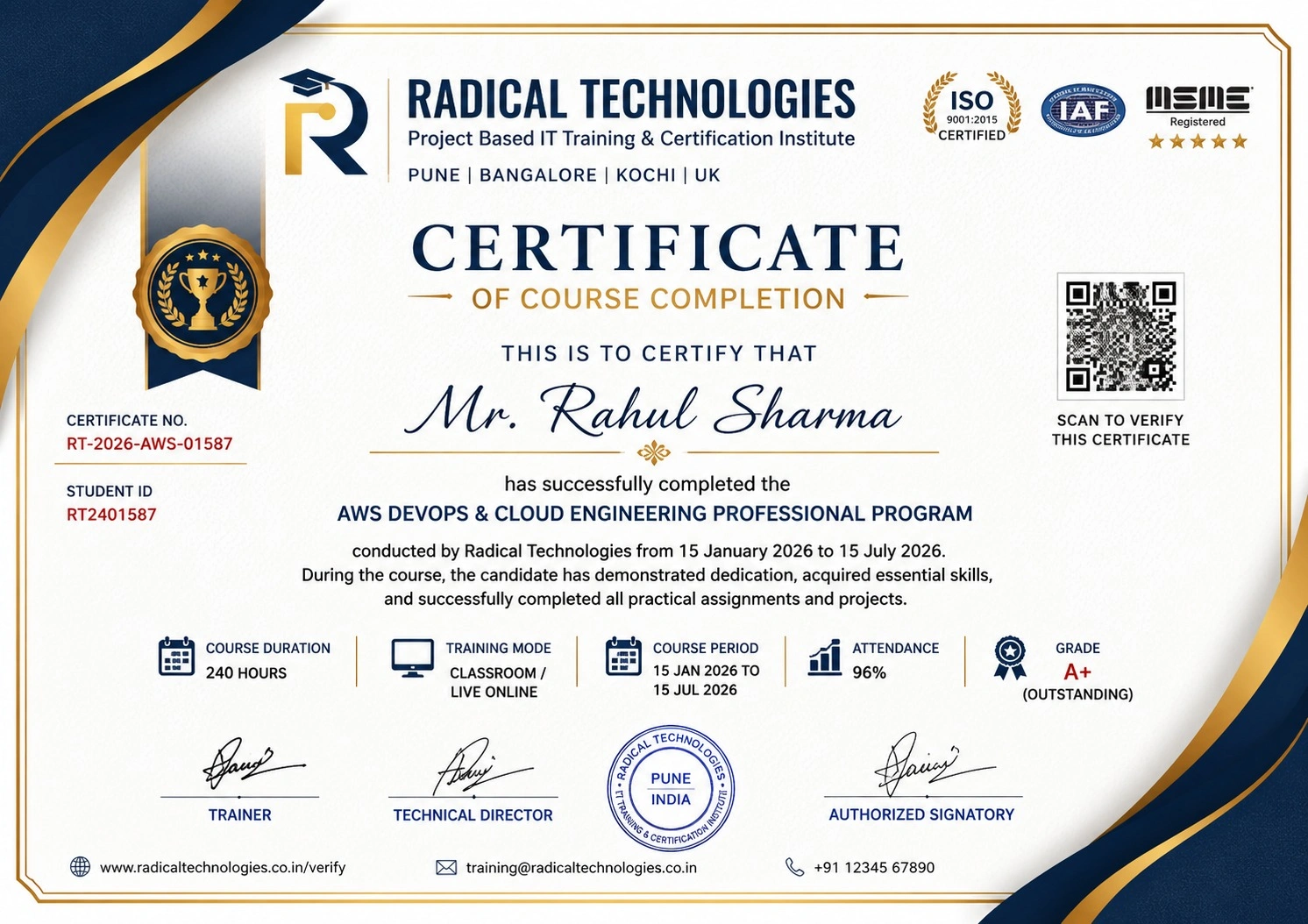
Radical Technologies is the leading IT certification institute in Pune, offering globally recognized certifications across various domains. With expert trainers and comprehensive materials, we ensure students gain in-depth knowledge and hands-on experience to excel in their careers. Our certification programs are tailored to meet industry standards — from cloud technologies to data science — empowering individuals to stay ahead in the ever-evolving tech landscape.
Career Services
At Radical Technologies, we are committed to your success beyond the classroom. Our 100% Job Assistance program ensures that you are not only equipped with industry-relevant skills but also guided through the job placement process. With personalised resume building, interview preparation, and access to our extensive network of hiring partners, we help you take the next step confidently into your IT career.
Career Support
Join our Brush-up Session & get support until you find a job!
Get StartedRadical Learning Eco-System
Exam Simulator
Cloud SandBox
Hands-on Cloud Lab
Developer Coding Ground
Student Reviews
Course Rating
I recently completed the WebLogic Admin Course in Bengaluru, and I must say it was an exceptional learning experience. The instructors at this institute provided in-depth knowledge and practical skills that have helped me advance my career in WebLogic administration.
The WebLogic Admin Certification in Bengaluru offered by this institute was thorough and well-structured. The hands-on training allowed me to grasp complex concepts, and I am now confident in my ability to manage WebLogic servers.
The WebLogic Admin Classes in Bengaluru are top-notch. The faculty members are experts in the field, and they provide excellent support throughout the course. I highly recommend this course for anyone looking to specialize in WebLogic administration.
I’m extremely satisfied with my decision to join the WebLogic Admin Institute in Bengaluru. The curriculum is up-to-date, and the learning environment is conducive to mastering WebLogic administration skills.
The WebLogic Admin Training in Bengaluru gave me the practical exposure I needed. From configuring WebLogic domains to troubleshooting server issues, the training covered everything necessary for real-world applications.
I opted for WebLogic Admin Corporate Training in Bengaluru for my team, and the results were amazing. The course content was customized to suit our organizational needs, and we gained valuable skills to manage WebLogic environments efficiently.
I took the WebLogic Admin Online Classes in Bengaluru, and it was a fantastic learning experience. The course provided flexibility, and I could learn at my own pace while receiving expert guidance from instructors.
The WebLogic Admin Online Course in Bengaluru was a great choice for me, as it allowed me to learn from anywhere. The virtual labs and interactive sessions made the learning process much more effective and engaging.
The WebLogic Admin Online Training in Bengaluru helped me acquire the skills I needed to manage large-scale WebLogic servers. The instructors were responsive and always available to clear doubts, which greatly enhanced my learning.
Completing the WebLogic Admin Online Certification in Bengaluru has opened up new career opportunities for me. The course not only provided technical knowledge but also gave me the confidence to manage WebLogic environments independently.
The WebLogic Admin Course in Bengaluru is the perfect blend of theory and practical sessions. The trainers ensure you gain hands-on experience, making you job-ready upon completion.
After completing the WebLogic Admin Certification in Bengaluru, I felt much more equipped to handle the complexities of WebLogic administration. The training covered everything from deployment to performance optimization.
Joining the WebLogic Admin Classes in Bengaluru was one of the best decisions of my career. The instructors made sure I understood every topic clearly, and the practical approach was really beneficial.
The WebLogic Admin Institute in Bengaluru offers an excellent training program. It’s not just about learning WebLogic but also about understanding its role in the bigger picture of enterprise application deployment.
The WebLogic Admin Training in Bengaluru helped me gain confidence in managing WebLogic environments. The sessions were interactive, and I was able to work on real-time scenarios, which made all the difference.
I took WebLogic Admin Corporate Training in Bengaluru, and it was tailored to my company's needs. The course was comprehensive, and the trainer’s expertise made the learning experience smooth and impactful.
The WebLogic Admin Online Classes in Bengaluru were a great fit for my busy schedule. I was able to complete the training while working, and the interactive learning made it engaging and fun.
WebLogic Admin Online Course in Bengaluru is highly recommended for professionals who prefer learning at their own pace. The course material is detailed, and the live sessions were incredibly informative.
The WebLogic Admin Online Training in Bengaluru was thorough and well-paced. I gained in-depth knowledge of server management, clustering, and security configurations, which have been crucial in my current job role.
After completing the WebLogic Admin Online Certification in Bengaluru, I feel ready to take on any challenge in WebLogic administration. The course provided all the necessary tools to succeed in the field.
The WebLogic Admin Course in Bengaluru was a complete package, offering not just technical knowledge but also the best practices for managing WebLogic servers efficiently in a production environment.
The WebLogic Admin Certification in Bengaluru offered by this institute exceeded my expectations. The trainers were highly knowledgeable, and the curriculum was updated to match the latest industry standards.
I am grateful for the WebLogic Admin Classes in Bengaluru. The course gave me the hands-on experience I needed to work with real WebLogic environments, and the practical assignments were invaluable.
The WebLogic Admin Institute in Bengaluru is a great place to learn about WebLogic administration. The trainers are industry experts, and the training environment fosters a deep understanding of the concepts.
The WebLogic Admin Training in Bengaluru was an enriching experience. The trainers were always available for clarification, and I appreciated the hands-on training, which helped me master WebLogic administration quickly.






Frequently Asked Questions
15 questions about the WEBLOGIC ADMIN course.
01 What is WebLogic Server, and why is it used in enterprise environments?
02 What are the key components of a WebLogic Server domain?
Admin Server: The central management server for the domain.
Managed Servers: Servers that run application instances.
Clusters: Groups of managed servers for load balancing and failover.
Node Managers: For remote server management.
Deployments: Applications deployed across the domain.
03 How do you create and configure a WebLogic domain?
Install WebLogic Server.
Run the Configuration Wizard to create the domain.
Specify the domain name, administrative server, and managed servers.
Configure security settings, data sources, and JMS queues.
Deploy applications to the domain as required.
04 What is the purpose of WebLogic clustering?
05 How do you monitor the performance of WebLogic Server?
WebLogic Diagnostic Framework (WLDF) for real-time monitoring.
Oracle Enterprise Manager for detailed analytics and insights.
JVM metrics like memory usage, garbage collection stats, and thread performance.
Server logs for error tracking and resource usage.
06 What are the common security configurations in WebLogic?
SSL (Secure Sockets Layer) for encrypted communication.
Authentication providers to control access.
Role-based access control (RBAC) for defining user roles and permissions.
WebLogic security realms for centralized security management.
07 How do you deploy an application in WebLogic Server?
Package the application (e.g., WAR, EAR).
Log into the Admin Console.
Navigate to the Deployments section and select the “Deploy” option.
Choose the deployment type and the target server or cluster.
Complete the deployment process, configuring any necessary data sources or application-specific settings.
08 What are the steps to configure JDBC Data Sources in WebLogic?
Log into the Admin Console.
Navigate to Services > Data Sources.
Create a new data source, providing the necessary database connection details (URL, username, password).
Test the connection to ensure the configuration is correct.
Deploy the data source to the appropriate servers or clusters.
09 How do you perform a backup of WebLogic Server?
Backup domain configurations including config.xml and other domain-specific files.
Backup the database and other dependent systems.
Use WebLogic’s Node Manager for server shutdown and backup procedures.
Ensure backup of application deployments and logs for disaster recovery.
10 What are the common performance tuning practices for WebLogic?
Adjusting JVM heap sizes to optimize memory usage.
Configuring thread pools to handle a larger number of concurrent requests.
Optimizing garbage collection settings to minimize latency.
Enabling logging at the appropriate level for troubleshooting without impacting performance.
11 What is WebLogic Node Manager, and how is it used?
12 How does WebLogic handle failover in a clustered environment?
13 What is the role of WebLogic Server in SOA (Service-Oriented Architecture)?
14 How do you troubleshoot issues in WebLogic Server?
Check server logs for errors or warnings.
Monitor system resources to identify bottlenecks (CPU, memory).
Enable debugging and diagnostic logging for deeper insights.
Use WLDF to track system metrics and request flows.
Validate configuration files for any misconfigurations.
15 What are the best practices for WebLogic Server maintenance?
Regularly applying patches to keep the server secure.
Monitoring server performance using automated tools.
Performing regular backups of domain configurations and data sources.
Testing disaster recovery plans to ensure quick recovery during system failures.
Cleaning up old logs and unused deployments to maintain server efficiency.
WEBLOGIC ADMIN Interview Questions
10 questions commonly asked in WEBLOGIC ADMIN interviews.
- 01 What are the key components of WebLogic Server, and how do they work together to ensure high availability and scalability?
- 02 Can you explain the process of creating and configuring a WebLogic domain? What are the key considerations when configuring a domain for a production environment?
- 03 Describe the role of managed servers in WebLogic and explain how clustering works to provide fault tolerance and load balancing.
- 04 How do you optimize JVM settings in WebLogic Server to improve application performance? What parameters would you typically adjust for high-traffic applications?
- 05 What are the best practices for securing WebLogic Server, including SSL configuration, role-based access control (RBAC), and user authentication?
- 06 Can you walk us through the process of deploying a Java EE application in WebLogic Server, and what common deployment issues should be avoided?
- 07 How do you handle WebLogic Server performance monitoring and troubleshooting? What tools or logs do you rely on to identify and resolve issues?
- 08 What steps would you take to configure and manage WebLogic Server integration with an Oracle or MySQL database? How do you ensure reliable database connectivity?
- 09 Explain the process of applying patches and updates to WebLogic Server. How do you ensure minimal downtime during the patching process?
- 10 What is your experience with disaster recovery planning for WebLogic environments? How do you configure backup and recovery procedures to ensure business continuity in case of a system failure?
WebLogic Admin Course Certification With Training In Pune
Radical Technologies is the leading institute in Bangalore for WebLogic Admin Course Training. With years of experience in delivering high-quality training, we specialize in providing comprehensive WebLogic Admin Classes in Bengaluru. Our mission is to equip students with the skills and knowledge required to excel in WebLogic administration, empowering them to take on challenging roles in the IT industry.
At Radical Technologies, we offer a wide range of training options, including WebLogic Admin Certification in Bengaluru, which ensures that you not only gain practical skills but also earn a credential that validates your expertise. Whether you’re a beginner or an experienced professional, our WebLogic Admin Training in Bengaluru is designed to meet your needs and help you build a solid foundation in WebLogic Server management.
Our WebLogic Admin Institute in Bengaluru provides a hands-on learning environment with access to state-of-the-art facilities and real-world scenarios. The course covers everything from WebLogic Server installation to performance tuning, ensuring that students are job-ready upon completion.
For businesses and corporate clients, we offer WebLogic Admin Corporate Training in Bengaluru, which is tailored to your organization’s specific requirements. This training is designed to equip your team with the skills needed to manage and optimize WebLogic environments efficiently.
For those looking for flexibility, we also offer WebLogic Admin Online Classes in Bengaluru. Our WebLogic Admin Online Course in Bengaluru allows students to learn at their own pace, making it ideal for professionals balancing work and study. The WebLogic Admin Online Training in Bengaluru is comprehensive and ensures you gain all the practical skills necessary to succeed. Additionally, our WebLogic Admin Online Certification in Bengaluru provides a globally recognized certification that enhances your career prospects.
At Radical Technologies, our focus is on delivering top-notch training with a practical approach, ensuring that you master WebLogic administration concepts and gain hands-on experience that directly translates to your job responsibilities. Join us today and take your career to the next level with our WebLogic Admin Course in Bengaluru.
Our Alumni Work At



























Related Courses



WEBLOGIC ADMIN Course In Other Cities
Online Batches Available For These Areas
Ambegaon Budruk | Aundh | Baner | Bavdhan Khurd | Bavdhan Budruk | Balewadi | Shivajinagar | Bibvewadi | Bhugaon | Bhukum | Dhankawadi | Dhanori | Dhayari | Erandwane | Fursungi | Ghorpadi | Hadapsar | Hingne Khurd | Karve Nagar | Kalas | Katraj | Khadki | Kharadi | Kondhwa | Koregaon Park | Kothrud | Lohagaon | Manjri | Markal | Mohammed Wadi | Mundhwa | Nanded | Parvati Hill | Panmala | Pashan | Pirangut | Shivane | Sus | Undri | Vishrantwadi | Vitthalwadi | Vadgaon Khurd | Vadgaon Budruk | Vadgaon Sheri | Wagholi | Wanwadi | Warje | Yerwada | Akurdi | Bhosari | Chakan | Charholi Budruk | Chikhli | Chimbali | Chinchwad | Dapodi | Dehu Road | Dighi | Dudulgaon | Hinjawadi | Kalewadi | Kasarwadi | Maan | Moshi | Phugewadi | Pimple Gurav | Pimple Nilakh | Pimple Saudagar | Pimpri | Ravet | Rahatani | Sangvi | Talawade | Tathawade | Thergaon | Wakad
WEBLOGIC ADMIN
IT Training Programme
100% placement assistance