
6 Month Mentorship Program in Data Science & Machine Learning
With GenAI & Agentic AI, from Basic to Advanced. Six specialized tracks, one a month — Python & Data Science Libraries | Statistics & Probability | Machine Learning | Deep Learning | Generative AI & LLMs | Agentic AI & AI Engineering. The methodology is Learn → Code → Analyze → Experiment → Build → Deploy → Troubleshoot → Interview, across 240 hours, 100+ hands-on labs, 60+ assignments, 25+ mini projects, 6 major capstones and 1 integrated enterprise capstone. No prior Python experience is required — Month 1 starts at fundamentals and the programme finishes with RAG, agentic AI and production AI engineering.
6 Month Mentorship Program in Data Science & Machine Learning
With GenAI & Agentic AI — From Basic to Advanced
Tools you'll master
Enquire Now
Get course fees, batch dates & a callback
Why This Course?
Prerequisites
Programme Overview
6 specialized tracks, one a month — Python & Data Science Libraries, Statistics & Probability, Machine Learning, Deep Learning, Generative AI & LLMs, and Agentic AI & AI Engineering. Each month ends in a major outcome, from a Python Data Science Foundation through to AI Engineer / Agentic AI skills.
Month 1 — Python & Data Science Libraries
Build a strong programming and data-science foundation using Python and industry-standard libraries for data preparation, exploration, visualization and machine-learning workflows. Outcome: Python Data Science Foundation.
Month 2 — Statistics & Probability
The mathematical and statistical foundation required for machine learning, experimentation, predictive analytics and data-driven decision-making. Outcome: Statistical & Analytical Foundation.
Month 3 — Machine Learning
Practical machine-learning skills covering supervised and unsupervised learning, feature engineering, model evaluation, optimization and deployment fundamentals. Outcome: Machine Learning Engineer Foundation.
Month 4 — Deep Learning
Neural networks and deep-learning architectures for computer vision, NLP, sequence modeling and modern AI applications. Outcome: Deep Learning / Neural Network Skills.
Month 5 — Generative AI & LLMs
Modern Generative AI and Large Language Model technologies, including transformers, prompting, embeddings, RAG, fine-tuning concepts and production-oriented LLM applications. Outcome: GenAI / LLM Engineer Foundation.
Month 6 — Agentic AI & AI Engineering
Production-oriented AI applications and autonomous agent workflows that reason through tasks, call tools, access enterprise data and execute controlled multi-step workflows. Outcome: AI Engineer / Agentic AI Skills.
Who is this programme for?
Whether you're a fresher, a Software Developer, a Data or Business Analyst, a statistician or already working in IT — this mentorship is built to take you into a Data Scientist, Machine Learning Engineer, Deep Learning Engineer, Generative AI Engineer, LLM Engineer or Agentic AI Engineer role.
Students & Freshers
No prior Python experience needed — Month 1 starts at fundamentals and builds towards Junior Data Scientist and Machine Learning Analyst roles.
Software Developers
Move into Machine Learning Engineer, AI Application Engineer and AI/ML Solutions Engineer roles.
Data & Business Analysts
Step up from reporting into Data Scientist, Applied Data Scientist and Python Data Scientist roles with statistics and ML.
Statisticians & Researchers
Apply your quantitative background to Deep Learning Engineer, NLP Engineer and Computer Vision Engineer roles.
AI-Curious Engineers
Target Generative AI Engineer, LLM Engineer and RAG Engineer roles through transformers, embeddings and RAG pipelines.
Automation-Focused Engineers
Target Agentic AI Engineer and AI Automation Engineer roles with tool calling, multi-agent systems and guardrails.
Course Curriculum
6 tracks • 36 modules • one track a month, with labs, assignments and a capstone in each
Build a strong programming and data-science foundation using Python and industry-standard libraries for data preparation, exploration, visualization and machine-learning workflows.
Course Content
Prerequisites:
- Basic computer knowledge
- Basic mathematics
- Logical reasoning
- No prior Python experience required
Topics:
- Data Science lifecycle
- Python ecosystem
- Variables and data types
- Operators
- Conditions
- Loops
- Functions
- Modules and packages
- Exception handling
- File handling
- Object-oriented programming fundamentals
- Virtual environments
- Jupyter Notebook
Topics:
- Lists, tuples, sets, dictionaries
- Functions
- Lambda functions
- List comprehensions
- Iterators and generators
- Modules and packages
- Exception handling
- File processing
- JSON/CSV
- Regular expressions
- OOP
- APIs
- Logging
Topics:
- Arrays
- Indexing
- Broadcasting
- Vectorization
- Mathematical operations
- Statistical operations
Topics:
- Series
- DataFrames
- Data loading
- Data cleaning
- Missing values
- Duplicate handling
- Filtering
- GroupBy
- Merge/Join
- Pivot
- Transformation
Topics:
- Matplotlib
- Seaborn
- Distribution plots
- Correlation plots
- Business visualizations
Labs:
- Python Data Science Environment Lab
- Python Programming Lab
- File Processing Lab
- JSON/CSV Processing Lab
- NumPy Array Lab
- NumPy Statistical Operations Lab
- Pandas DataFrame Lab
- Data Cleaning Lab
- Missing-Value Handling Lab
- Pandas Merge & Join Lab
- GroupBy & Aggregation Lab
- Exploratory Data Analysis Lab
- Matplotlib Visualization Lab
- Seaborn Visualization Lab
- REST API Data Extraction Lab
Assignments:
- Python programming exercises
- Data-cleaning assignment
- NumPy analysis
- Pandas transformation
- EDA assignment
- Visualization assignment
- API data extraction
- Automated data-analysis report
Mini Projects:
- E-Commerce Data Analysis
- Customer Data Exploration
- Employee Analytics
- Financial Data Analysis
Project Flow:
- Data → Cleaning → EDA → Statistical Analysis → Visualization → Business Insights
Scenarios:
- Clean a large customer dataset
- Identify duplicate transactions
- Analyze missing values
- Extract data from an API
- Analyze sales trends
- Detect outliers
- Automate recurring analysis
Troubleshooting:
- Pandas memory issue
- Incorrect DataFrame joins
- Missing values
- Incorrect data types
- API failure
- File encoding issue
- Visualization errors
Tools:
- Python
- Jupyter
- VS Code
- NumPy
- Pandas
- Matplotlib
- Seaborn
- SciPy
- Git
- REST APIs
Best Practices:
- PEP 8
- Modular code
- Virtual environments
- Exception handling
- Logging
- Data validation
- Version control
- Reproducible notebooks
Mock Interviews
- › Python coding
- › NumPy
- › Pandas
- › EDA
- › Data cleaning
- › Visualization
- › Practical coding
Certifications:
- Python Institute certifications
- IBM Data Science Professional Certificate
- Google Advanced Data Analytics Professional Certificate
Develop the mathematical and statistical foundation required for machine learning, experimentation, predictive analytics and data-driven decision-making.
Course Content
Prerequisites:
- Basic mathematics
- Python fundamentals
- Basic data analysis
Topics:
- Population vs sample
- Variables
- Data types
- Descriptive vs inferential statistics
- Probability concepts
- Random variables
- Statistical distributions
Topics:
- Mean
- Median
- Mode
- Range
- Variance
- Standard deviation
- Percentiles
- Quartiles
- IQR
- Skewness
- Kurtosis
Topics:
- Probability rules
- Conditional probability
- Bayes theorem
- Independent/dependent events
- Random variables
- Expected value
Topics:
- Normal distribution
- Binomial distribution
- Poisson distribution
- Uniform distribution
- Exponential distribution
- Sampling distributions
Topics:
- Sampling
- Central Limit Theorem
- Confidence intervals
- Hypothesis testing
- Null/alternative hypothesis
- p-values
- Type I/Type II errors
- Statistical significance
Topics:
- Correlation
- Covariance
- Regression fundamentals
- ANOVA
- Chi-square
- A/B testing
Labs:
- Descriptive Statistics Lab
- Probability Simulation Lab
- Normal Distribution Lab
- Sampling Lab
- Central Limit Theorem Lab
- Confidence Interval Lab
- Hypothesis Testing Lab
- T-Test Lab
- Chi-Square Lab
- ANOVA Lab
- Correlation Analysis Lab
- A/B Testing Lab
- Outlier Detection Lab
- Statistical Experimentation Lab
- Python Statistical Analysis Lab
Assignments:
- Statistical summary
- Probability simulation
- Distribution analysis
- Confidence interval
- Hypothesis testing
- A/B test
- Correlation analysis
- Business experiment report
Mini Projects:
- A/B Testing for Marketing Campaign
- Customer Behavior Statistical Analysis
- Sales Distribution Analysis
- Product Performance Experiment
Project Flow:
- Business Problem → Sampling → Statistical Test → Analysis → Interpretation → Recommendation
Scenarios:
- Determine whether a new campaign performs better
- Test product conversion changes
- Analyze customer behavior
- Identify statistically significant differences
- Measure sales variation
- Determine whether two groups differ
Troubleshooting:
- Wrong statistical test
- Biased sample
- Incorrect interpretation of p-value
- Outlier distortion
- Correlation mistaken for causation
- Insufficient sample size
Tools:
- Python
- NumPy
- Pandas
- SciPy
- Statsmodels
- Jupyter
- Excel
- Power BI
Best Practices:
- Define hypothesis clearly
- Select appropriate tests
- Validate assumptions
- Report uncertainty
- Avoid p-value-only conclusions
- Check sample quality
- Distinguish statistical and practical significance
Mock Interviews
- › Probability
- › Distributions
- › Hypothesis testing
- › p-values
- › A/B testing
- › Statistics case studies
Certifications:
- Google Advanced Data Analytics Professional Certificate
- IBM Data Science Professional Certificate
- SAS statistical/data science credentials
Develop practical machine-learning skills covering supervised and unsupervised learning, feature engineering, model evaluation, optimization and deployment fundamentals.
Course Content
Prerequisites:
- Python
- Pandas/NumPy
- Statistics & probability
- Basic linear algebra concepts
Topics:
- Machine Learning concepts
- AI vs ML
- Supervised learning
- Unsupervised learning
- Semi-supervised learning
- Training/validation/test datasets
- Features and targets
- Bias and variance
- Overfitting and underfitting
- Model evaluation
Topics:
- Data cleaning
- Missing values
- Encoding
- Scaling
- Feature engineering
- Feature selection
- Train/test split
- Cross-validation
Topics:
- Linear regression
- Multiple regression
- Polynomial regression
- Regularization
- Ridge
- Lasso
Topics:
- Logistic regression
- KNN
- Decision trees
- Random Forest
- Gradient boosting
- XGBoost concepts
- SVM
Topics:
- K-Means
- Hierarchical clustering
- DBSCAN
- Dimensionality reduction
- PCA
Topics:
- MAE
- MSE
- RMSE
- R²
- Accuracy
- Precision
- Recall
- F1-score
- ROC-AUC
- Confusion matrix
Topics:
- Hyperparameter tuning
- Grid Search
- Random Search
- Ensemble learning
- Feature importance
- Explainability fundamentals
Labs:
- ML Environment Setup Lab
- Data Preprocessing Lab
- Feature Engineering Lab
- Linear Regression Lab
- Logistic Regression Lab
- Decision Tree Lab
- Random Forest Lab
- XGBoost Lab
- KNN Lab
- SVM Lab
- K-Means Clustering Lab
- PCA Lab
- Cross-Validation Lab
- Hyperparameter Tuning Lab
- Model Evaluation Lab
- Feature Importance Lab
Assignments:
- Regression model
- Classification model
- Feature-engineering assignment
- Model comparison
- Hyperparameter optimization
- Customer segmentation
- Churn prediction
- Model evaluation report
Mini Projects:
- House Price Prediction
- Customer Churn Prediction
- Credit Risk Classification
- Customer Segmentation
- Sales Forecasting
Project Flow:
- Business Problem → Data → EDA → Feature Engineering → Model Training → Evaluation → Tuning → Prediction → Model Report
Scenarios:
- Predict customer churn
- Identify fraudulent transactions
- Predict sales
- Classify customers
- Segment customers
- Predict loan risk
- Rank important features
Troubleshooting:
- Overfitting
- Underfitting
- Data leakage
- Class imbalance
- Poor model accuracy
- Feature mismatch
- Missing production features
- Model performance degradation
Tools:
- Python
- Scikit-learn
- XGBoost
- Pandas
- NumPy
- SciPy
- MLflow
- Jupyter
- Git
Best Practices:
- Proper train/test separation
- Prevent data leakage
- Cross-validation
- Feature engineering
- Reproducibility
- Model versioning
- Experiment tracking
- Explainability
Mock Interviews
- › ML algorithms
- › Regression
- › Classification
- › Feature engineering
- › Metrics
- › Overfitting
- › Case studies
Certifications:
- AWS Certified Machine Learning Engineer – Associate
- Google Professional Machine Learning Engineer
- Microsoft Azure AI Engineer Associate
- IBM Machine Learning credentials
Learn neural networks and deep-learning architectures for computer vision, NLP, sequence modeling and modern AI applications.
Course Content
Prerequisites:
- Python
- NumPy/Pandas
- Statistics
- Machine Learning fundamentals
- Basic linear algebra
Topics:
- Neural networks
- Neurons
- Weights and biases
- Activation functions
- Forward propagation
- Backpropagation
- Loss functions
- Optimizers
- Gradient descent
- Epochs and batches
Topics:
- Perceptron
- MLP
- Activation functions
- Loss functions
- Optimizers
- Learning rates
- Regularization
- Dropout
- Batch normalization
Topics:
- Convolution
- Filters
- Pooling
- Feature maps
- CNN architecture
- Image classification
- Transfer learning
Topics:
- RNN
- LSTM
- GRU
- Sequence classification
- Time-series fundamentals
Topics:
- Text preprocessing
- Tokenization
- Embeddings
- Text classification
- Sentiment analysis
Topics:
- Transfer learning
- Data augmentation
- Model tuning
- GPU training
- Model evaluation
Labs:
- Neural Network Environment Lab
- Perceptron Lab
- MLP Classification Lab
- Activation Function Lab
- Backpropagation Lab
- CNN Image Classification Lab
- Image Augmentation Lab
- Transfer Learning Lab
- RNN Lab
- LSTM Lab
- GRU Lab
- Text Classification Lab
- Sentiment Analysis Lab
- Model Optimization Lab
- GPU Training Lab
Assignments:
- Neural network implementation
- Image classification
- CNN optimization
- Transfer-learning exercise
- LSTM sequence analysis
- NLP classification
- Model comparison
- Deep-learning performance analysis
Mini Projects:
- Image Classification System
- Customer Sentiment Analyzer
- Document Classification
- Time-Series Prediction
- Visual Product Classifier
Project Flow:
- Data → Preprocessing → Deep Learning Model → Training → Evaluation → Optimization → Prediction → Deployment Prototype
Scenarios:
- Image classification
- Customer sentiment analysis
- Document classification
- Text categorization
- Time-series prediction
- Transfer-learning implementation
Troubleshooting:
- Vanishing/exploding gradients
- Overfitting
- Poor convergence
- GPU memory issues
- Class imbalance
- Slow training
- Incorrect tensor dimensions
Tools:
- TensorFlow
- Keras
- PyTorch
- Scikit-learn
- Jupyter
- CUDA/GPU environments
- Hugging Face
Best Practices:
- Proper dataset splitting
- Data augmentation
- Regularization
- Transfer learning
- Experiment tracking
- Model versioning
- Reproducible training
- Monitor training/validation metrics
Mock Interviews
- › Neural networks
- › CNN
- › RNN
- › LSTM
- › Transfer learning
- › NLP
- › Model troubleshooting
Certifications:
- TensorFlow Developer-related credentials
- AWS Machine Learning Engineer
- Google Professional Machine Learning Engineer
- Microsoft Azure AI Engineer Associate
Learn modern Generative AI and Large Language Model technologies, including transformers, prompting, embeddings, RAG, fine-tuning concepts and production-oriented LLM applications.
Course Content
Prerequisites:
- Python
- Machine Learning fundamentals
- Deep Learning fundamentals
- Basic NLP concepts
Topics:
- Generative AI
- LLMs
- NLP
- Transformers
- Tokens
- Embeddings
- Attention
- Context windows
- Foundation models
- Inference
Topics:
- Transformer architecture
- Self-attention
- Encoder/decoder concepts
- Tokenization
- Embeddings
- Context windows
- Model inference
Topics:
- Zero-shot prompting
- Few-shot prompting
- Role prompting
- Structured outputs
- Chain-of-thought concepts
- Prompt templates
- Prompt evaluation
Topics:
- Document ingestion
- Chunking
- Embeddings
- Vector databases
- Retrieval
- Context construction
- RAG pipeline
- Metadata filtering
- RAG evaluation
Topics:
- Chatbots
- Question answering
- Document analysis
- Text summarization
- Information extraction
- Code assistants
- Enterprise knowledge assistants
Topics:
- Instruction tuning
- Parameter-efficient fine-tuning
- LoRA/PEFT concepts
- Dataset preparation
- Evaluation
Topics:
- Prompt injection
- Data leakage
- Hallucinations
- Jailbreak concepts
- Access control
- Output validation
Labs:
- LLM API Integration Lab
- Transformer Fundamentals Lab
- Tokenization Lab
- Prompt Engineering Lab
- Structured Output Lab
- Embeddings Lab
- Vector Database Lab
- RAG Pipeline Lab
- Document Q&A Lab
- Enterprise Knowledge Assistant Lab
- LLM Evaluation Lab
- Fine-Tuning Concepts Lab
- LoRA/PEFT Lab
- Prompt Injection Testing Lab
- LLM Security Lab
- AI Application Deployment Lab
Assignments:
- Prompt engineering
- LLM application
- Embedding generation
- Vector search
- RAG implementation
- RAG evaluation
- LLM security assessment
- Fine-tuning experiment
Mini Projects:
- AI Document Assistant
- RAG-Based Knowledge Assistant
- Enterprise Q&A Assistant
- AI Resume Analyzer
- Intelligent Document Summarizer
Project Flow:
- Documents → Chunking → Embeddings → Vector DB → Retrieval → LLM → Grounded Response → Evaluation
Scenarios:
- Build enterprise knowledge assistant
- Search internal documents using natural language
- Summarize large documents
- Extract structured information
- Create an AI support assistant
- Build domain-specific RAG
Troubleshooting:
- Hallucination
- Poor retrieval
- Incorrect chunking
- Embedding mismatch
- Context-window limitations
- Slow LLM responses
- Prompt injection
- Sensitive data leakage
Tools:
- Python
- Hugging Face
- Transformers
- OpenAI/Azure OpenAI
- LangChain
- LlamaIndex
- Vector databases
- MLflow
- REST APIs
Best Practices:
- Ground responses with trusted data
- Evaluate retrieval quality
- Validate outputs
- Protect sensitive data
- Implement access control
- Monitor token usage
- Track model performance
- Test adversarial prompts
Mock Interviews
- › Transformers
- › LLMs
- › Prompting
- › Embeddings
- › RAG
- › Vector DB
- › Fine-tuning
- › AI security
Certifications:
- AWS Certified AI Practitioner
- Microsoft Azure AI Engineer Associate
- Google Cloud Generative AI credentials
- Databricks AI/ML credentials
- Hugging Face ecosystem certifications/courses
Build production-oriented AI applications and autonomous agent workflows that can reason through tasks, call tools, access enterprise data and execute controlled multi-step workflows.
Course Content
Prerequisites:
- Python
- Machine Learning
- Deep Learning
- GenAI & LLM fundamentals
- APIs and JSON
Topics:
- AI Engineering
- AI agents
- Agent architecture
- Tool calling
- Function calling
- Planning
- Memory
- Agent workflows
- Multi-agent systems
- Human-in-the-loop
- AI evaluation
- AI security
Topics:
- AI application architecture
- LLM APIs
- Prompt templates
- Structured outputs
- Function calling
- Tool integration
- API orchestration
- Model selection
- AI application lifecycle
Topics:
- Agent architecture
- Planning
- Reasoning workflows
- Tool usage
- Memory
- Short-term/long-term memory concepts
- Agent state
- Multi-step workflows
- Multi-agent systems
- Human approval
Topics:
- Data-analysis agent
- SQL agent
- Research agent
- Document agent
- ML assistant
- Model-monitoring agent
- Data-quality agent
Topics:
- Evaluation
- Observability
- Guardrails
- Cost optimization
- Latency
- Security
- Model monitoring
- Versioning
- Deployment
Labs:
- AI Engineering Environment Lab
- LLM API Integration Lab
- Function Calling Lab
- Tool Calling Lab
- AI Data Analysis Agent Lab
- SQL Agent Lab
- Python Analytics Agent Lab
- RAG Agent Lab
- Agent Memory Lab
- Multi-Step Agent Workflow Lab
- Multi-Agent Collaboration Lab
- Human-in-the-Loop Lab
- AI Guardrails Lab
- AI Evaluation Lab
- Agent Observability Lab
- AI Application Deployment Lab
- AI Security Testing Lab
Assignments:
- Build an AI agent
- Tool-calling workflow
- SQL agent
- Data-analysis agent
- RAG agent
- Multi-step agent
- Agent evaluation
- Guardrail implementation
- AI application architecture
Mini Projects:
- AI Data Science Assistant
- Natural Language SQL Agent
- RAG Research Agent
- AI Data Analysis Agent
- AI Model Monitoring Assistant
- Multi-Agent Business Research System
Project Flow:
- User → AI Agent → Data → Python/SQL Tools → Analysis → Visualization → Explanation → Report
The System Can
- › Understand analytical questions
- › Select appropriate tools
- › Query data
- › Perform Python analysis
- › Generate visualizations
- › Explain findings
- › Generate reports
Project Flow:
- User → Orchestrator → Specialized Agents → Tools/APIs → Enterprise Data → Validation → Human Approval → Final Output
Possible Agents
- › Data Research Agent
- › SQL Agent
- › Python Analysis Agent
- › RAG Agent
- › Report Generation Agent
- › Validation Agent
Scenarios:
- Business user asks an AI agent to analyze sales
- Agent generates SQL and validates results
- Agent investigates an unusual KPI
- Agent searches enterprise documents
- Agent prepares an executive report
- AI system analyzes customer behavior
- Agent coordinates multiple analytical tools
- Agent investigates an ML model issue
Troubleshooting:
- Agent selects wrong tool
- Incorrect function parameters
- Hallucinated analysis
- Tool/API failure
- Agent loop
- Excessive token usage
- Incorrect retrieval
- Security violation
- Unauthorized data access
- Incorrect automated action
Tools:
- Python
- PyTorch
- TensorFlow
- Hugging Face
- OpenAI/Azure OpenAI
- LangChain
- LangGraph
- LlamaIndex
- MLflow
- Vector Databases
- REST APIs
- FastAPI
- Docker
- Git
Best Practices:
- Treat AI output as untrusted until validated
- Restrict agent permissions
- Use least-privilege tool access
- Implement guardrails
- Validate tool outputs
- Protect enterprise data
- Maintain audit logs
- Use human approval for high-impact actions
- Evaluate agents continuously
- Monitor cost and latency
- Version prompts, models and workflows
Mock Interviews
- › AI agents
- › LLMs
- › RAG
- › Tool calling
- › Function calling
- › AI architecture
- › Evaluation
- › Guardrails
- › AI security
Certifications:
- Microsoft Azure AI Engineer Associate
- AWS Certified AI Practitioner
- Google Cloud Generative AI credentials
- Google Professional Machine Learning Engineer
- Databricks AI/ML certifications
- Relevant cloud AI engineering certifications
Tools & Technologies
Every tool and library listed here is installed, configured and used in a hands-on lab session.
Python
Core Language
NumPy
Numerical Computing
Pandas
DataFrames & Cleaning
SciPy
Scientific & Statistical Computing
Matplotlib & Seaborn
Visualization
Jupyter
Interactive Notebooks
Scikit-learn
Classical ML
XGBoost
Gradient Boosting
MLflow
Experiment Tracking & Registry
PyTorch
Deep Learning Framework
TensorFlow
Deep Learning Framework
Keras
High-Level Neural Network API
Hugging Face
Models & Datasets
LLMs
Foundation Models
OpenAI / Azure OpenAI
Model APIs
Transformers
Model Architecture & Library
Embeddings & Vector DBs
Semantic Search
LangChain
LLM Application Framework
LangGraph
Agent Orchestration
LlamaIndex
Data Framework for LLMs
Function & Tool Calling
Agent Tool Integration
FastAPI
AI Service APIs
Docker
Containerization
Git & GitHub
Version Control
Cloud AI Platforms
Hosting & Deployment
Six months, six outcomes — and an AI portfolio you can walk an interviewer through.
A major capstone every month, two in Month 6, and one integrated final capstone — from a Python analytics platform and a statistical decision platform to an end-to-end ML prediction system, a deep learning application, an enterprise RAG assistant and a multi-agent AI platform.
End-to-End Python Data Science Analytics Platform
→Data → Cleaning → EDA
→Statistical Analysis → Visualization
→Business Insights
Outcome: Python Data Science Foundation
Take raw data through cleaning, exploratory analysis and statistics to visualizations and business insights, entirely in Python.
Business Experimentation & Statistical Decision Platform
→Business Problem → Sampling → Statistical Test
→Analysis → Interpretation
→Recommendation
Outcome: Statistical & Analytical Foundation
Frame a business problem as a testable hypothesis, sample it properly, run the right statistical test and turn the result into a recommendation.
End-to-End Machine Learning Prediction Platform
→Business Problem → Data → EDA
→Feature Engineering → Model Training
→Evaluation → Tuning → Prediction → Model Report
Outcome: Machine Learning Engineer Foundation
The full ML lifecycle on a real business problem — features, training, evaluation, tuning and a model report you can defend.
Enterprise Deep Learning Application
→Data → Preprocessing → Deep Learning Model
→Training → Evaluation → Optimization
→Prediction → Deployment Prototype
Outcome: Deep Learning / Neural Network Skills
Train, evaluate and optimize a deep-learning model on vision, text or sequence data, then stand up a deployment prototype.
Enterprise RAG & GenAI Application
→Documents → Chunking → Embeddings
→Vector DB → Retrieval → LLM
→Grounded Response → Evaluation
Outcome: GenAI / LLM Engineer Foundation
A grounded enterprise assistant — documents chunked and embedded into a vector database, retrieved into context, answered by an LLM and then evaluated.
Agentic Data Science Assistant
→User → AI Agent → Data
→Python / SQL Tools → Analysis → Visualization
→Explanation → Report
An agent that picks its own tools and explains what it found
The agent interprets an analytical question, selects the right tool, queries the data, runs the Python analysis, visualizes it, explains the findings and writes the report.
Enterprise Agentic AI Platform
→User → Orchestrator → Specialized Agents
→Tools / APIs → Enterprise Data
→Validation → Human Approval → Final Output
An orchestrator coordinating specialized agents, with a human in the loop
A multi-agent system where a Data Research, SQL, Python Analysis, RAG, Report Generation and Validation agent each do their part, validated and approved before the final output.
Enterprise Data Science, GenAI & Agentic AI Platform
→Business Problem → Data → Python / EDA / Statistics
→Machine Learning → Deep Learning → LLM / GenAI
→RAG / Vector DB → AI Agents → Tools & APIs
→Evaluation & Guardrails → Deployment & Monitoring
Every track combined into one end-to-end AI environment
From a business problem and data collection through Python, EDA and statistics, machine learning and deep learning, then LLM/GenAI, RAG and a vector database, AI agents with tools and APIs, evaluation and guardrails, and finally deployment and monitoring.
All 8 projects go directly into your portfolio & resume — reviewed by mentors before you graduate.
See Sample Project ReportsUpcoming Batches
| Start Date | Time | Day | Mode | Enroll |
|---|---|---|---|---|
| 10/08/2026 | 08:00 PM – 09:30 PM | Weekday | Online | Enroll Now |
Why Radical Technologies
- Highly practical oriented training
- Installation support on your system
- 24/7 Email and Phone support
- 100% Placement Assistance
- Global Certification Preparation
- Trainer-Student Interactive Portal
- Assignments and Projects by Mentors
- Weekend / Weekdays / Morning / Evening batches
- 80:20 Practical and Theory ratio
- Real-life Case Studies
- Easy make-up for missed sessions
- PSI | Kryterion | Certification Test Centers
- Lifetime Video Classroom Access (coming soon)
- Resume Prep and Mock Interviews
- Learn 300+ courses at your own time
- 50,000+ Satisfied Learners
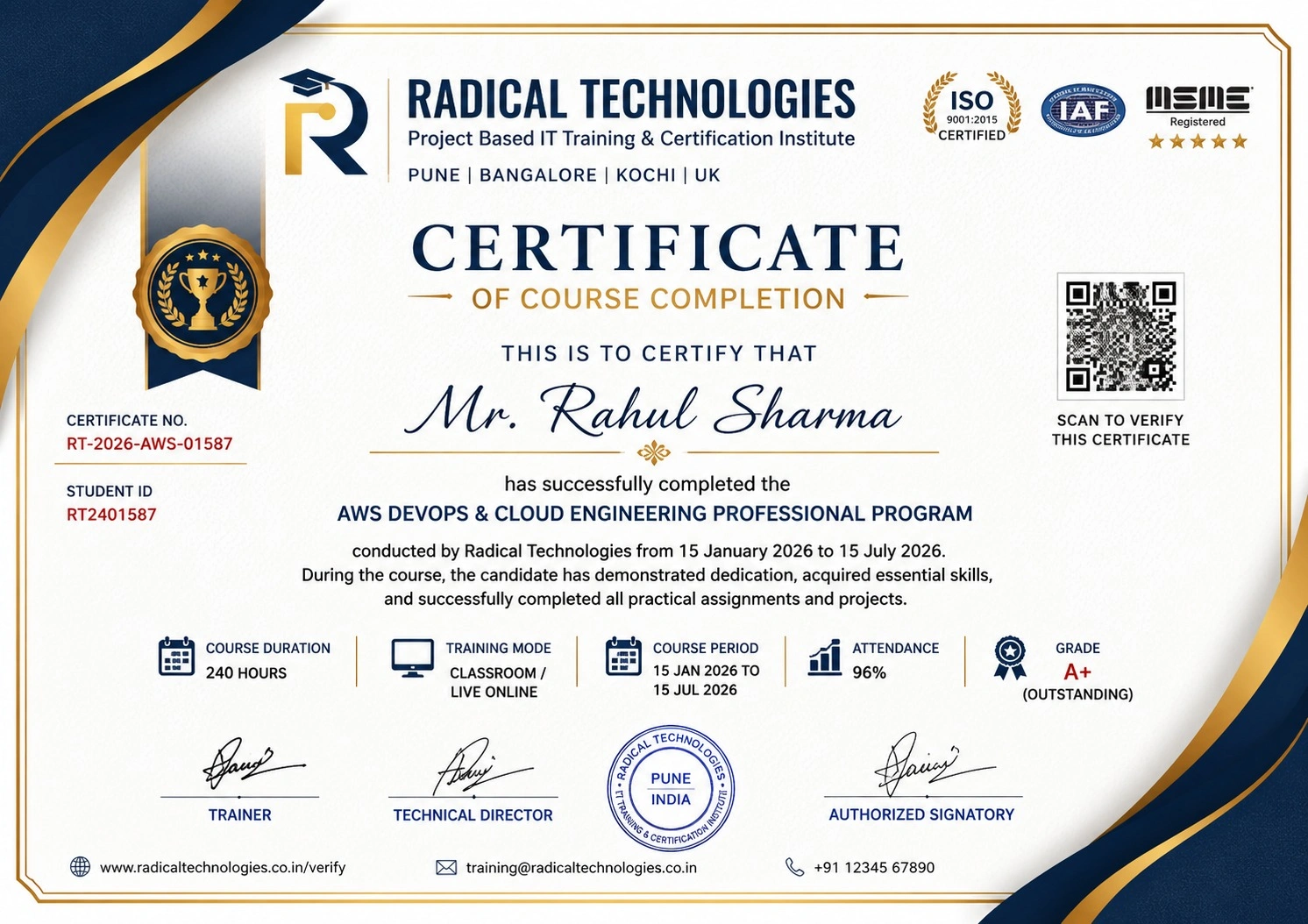
- Course Completion Certificate
- Practical Labs available
- Mentor Support available
- Doubt Clearing Session available
- 10% Discounted Global Certification
Like the Curriculum? Let's Get Started
Join 50,000+ students already enrolled at Radical Technologies
Global Certification
Radical Technologies is the leading IT certification institute in Pune, offering globally recognized certifications across various domains. With expert trainers and comprehensive materials, we ensure students gain in-depth knowledge and hands-on experience to excel in their careers. Our certification programs are tailored to meet industry standards — this mentorship maps to the Google Professional Machine Learning Engineer, AWS Machine Learning Engineer, Azure AI Engineer, AWS AI Practitioner and Databricks AI/ML credential tracks, empowering individuals to stay ahead in the ever-evolving data science and AI landscape.
Career Services
Our dedicated Placement Support Team works with you from day one — resume forwarding, technical interview preparation, HR interview preparation, career guidance, soft skills training, mock interviews and internship assistance, with access to 850+ Hiring Partners and placement assistance until you get hired.
Career Support
Join our Brush-up Session & get support until you find a job!
Get StartedRadical Learning Eco-System
Exam Simulator
Cloud SandBox
Hands-on Cloud Lab
Developer Coding Ground
Student Reviews
Course Rating

Our Alumni Work At









Related Courses
PG DIPLOMA — DATA SCIENCE & GEN AI
350-380 hrsPG DIPLOMA — DATA SCIENCE & GEN AI
The full-length PG Diploma — Python, Statistics, Data Science, Machine Learning, Artificial Intelligence and Generative AI (LLM, RAG, MCP, Agentic AI).
6 MONTH MENTORSHIP — DATA ANALYTICS
6 months6 MONTH MENTORSHIP — DATA ANALYTICS
The analytics-first companion track — Advanced Excel, SQL, Power BI, Python, Statistics and GenAI & Agentic AI for analytics.
6 MONTH MENTORSHIP — DATA ENGINEERING
240 hrs6 MONTH MENTORSHIP — DATA ENGINEERING
Python & SQL, Big Data, Cloud Data Engineering, Databricks, Pipelines and GenAI & Agentic AI — the data platform behind the models.
PG DIPLOMA — DATA ENGINEERING WITH AI
380-420 hrsPG DIPLOMA — DATA ENGINEERING WITH AI
Programming & Data Foundations, Data Storage, PySpark, Databricks, Cloud Data Engineering, Gen AI and MLOps across 8 courses.
Mentorship Programme In Other Cities
Online Batches Available For These Areas
Ambegaon Budruk | Aundh | Baner | Bavdhan Khurd | Bavdhan Budruk | Balewadi | Shivajinagar | Bibvewadi | Bhugaon | Bhukum | Dhankawadi | Dhanori | Dhayari | Erandwane | Fursungi | Ghorpadi | Hadapsar | Hingne Khurd | Karve Nagar | Kalas | Katraj | Khadki | Kharadi | Kondhwa | Koregaon Park | Kothrud | Lohagaon | Manjri | Markal | Mohammed Wadi | Mundhwa | Nanded | Parvati Hill | Panmala | Pashan | Pirangut | Shivane | Sus | Undri | Vishrantwadi | Vitthalwadi | Vadgaon Khurd | Vadgaon Budruk | Vadgaon Sheri | Wagholi | Wanwadi | Warje | Yerwada | Akurdi | Bhosari | Chakan | Charholi Budruk | Chikhli | Chimbali | Chinchwad | Dapodi | Dehu Road | Dighi | Dudulgaon | Hinjawadi | Kalewadi | Kasarwadi | Maan | Moshi | Phugewadi | Pimple Gurav | Pimple Nilakh | Pimple Saudagar | Pimpri | Ravet | Rahatani | Sangvi | Talawade | Tathawade | Thergaon | Wakad
6 Month Mentorship Program in Data Science & Machine Learning
With GenAI & Agentic AI — From Basic to Advanced
Tools you'll master