
RCDD – REGISTERED COMMUNICATIONS DISTRIBUTION DESIGNER
The RCDD (Registered Communications Distribution Designer) course is designed for professionals who want to build expertise in structured cabling and telecommunications infrastructure design. The training covers structured cabling, data center infrastructure, pathways and spaces, fiber and copper cabling, network distribution, grounding, documentation, and industry standards through practical exercises and real-world projects. Learners gain a better understanding of how to plan and design reliable communication systems for modern buildings and data centers. This course is ideal for network engineers, telecom professionals, ELV engineers, data center professionals, infrastructure designers, electrical engineers, and IT professionals looking to advance their careers in structured cabling and ICT infrastructure. Note: RCDD is a professional credential associated with Building Industry Consulting Service International (BICSI). The training below is designed as a 40-hour RCDD-oriented preparation and practical design program. It should not be presented as an official BICSI course unless delivered under the applicable BICSI authorization.
RCDD – REGISTERED COMMUNICATIONS DISTRIBUTION DESIGNER
IT Training Programme
100% placement assistance
Enquire Now
Get course fees, batch dates & a callback
What you'll learn
Programme Overview
26 sections covering the complete curriculum — a single, progressive learning arc.
Foundations & Core Concepts
Get hands-on with the fundamentals and architecture — the building blocks for everything that follows.
Hands-On Practical Training
Work through real exercises and assignments designed to mirror what you will do on the job.
Real-World Projects
Apply what you have learned to end-to-end projects that go straight into your portfolio.
Advanced Techniques
Go beyond the basics with advanced concepts, integrations and production-grade practices.
Ecosystem Integration
Understand how this technology connects with the broader tools and platforms used in the industry.
Performance & Interview Prep
Master optimization techniques and prepare for the technical interview questions employers actually ask.
Who is this programme for?
Whether you're already writing code, working with data, or supporting applications today — this programme is built to take you into a OTHER role.
Software Developers
Engineers who want to add this skill set to their toolkit
Analysts & Consultants
Professionals moving into a more technical, hands-on role
IT Professionals
System admins and support engineers upskilling into a new domain
Fresh Graduates
CS/IT graduates aiming for a job-ready technical role
Course Curriculum
26 sections • 510 lessons • 40 hours
Jump to Section
Total Duration
40 hours
100% Practical · Unlimited Doubt Sessions
01 1. Course Overview
Learning Path
Telecom Fundamentals → Standards → Structured Cabling → Copper → Fiber → Pathways & Spaces → Data Centers → Grounding → Wireless → Design & Documentation → Estimation → Troubleshooting → Capstone Project
02 2. Prerequisites
03 3. 40-HOUR COURSE STRUCTURE
ModuleTopicHours
Total
Telecom & Structured Cabling Training
40 Hours
04 4. Module 1 — Telecom & Structured Cabling Fundamentals 3 Hours
Fundamentals
Core Technical Topics
Hands-On Labs
- ›1. Identify Structured Cabling Components
- ›2. Build a Basic Rack Layout
- ›3. Design a Horizontal Cabling Architecture
- ›4. Create Patch Panel Connectivity
Assignment
- ›Design structured cabling for a three-floor office building.
Job Scenario
- ›Design a complete telecommunications infrastructure for a 500-user corporate office.
- ›
05 5. Module 2 — Standards, Codes & Design Principles 3 Hours
Core Technical Topics
Key Standards/References to Study
Hands-On Labs
- ›• Standards Selection Exercise
- ›• Cabling Compliance Review
- ›• Labeling Exercise
- ›• Pathway Compliance Review
Assignment
- ›Review a sample telecom design and identify standards/compliance issues.
Job Scenario
- ›Evaluate an existing cabling design and prepare a compliance-gap report.
06 6. Module 3 — Copper Cabling Systems 4 Hours
Core Technical Topics
Hands-On Labs
- ›1. Cat6 Termination
- ›2. Cat6A Termination
- ›3. Patch Panel Installation
- ›4. Keystone Jack Installation
- ›5. Copper Cable Testing
- ›6. Wire Map Testing
- ›7. PoE Testing
Assignment
- ›Design and document a Cat6A structured cabling system for an enterprise office.
Mini Project
07 7. Module 4 — Fiber Optic Cabling Systems 4 Hours
Fundamentals
Advanced Topics
Hands-On Labs
- ›1. Fiber Connector Identification
- ›2. Fiber Patch Panel Design
- ›3. Fiber Link Budget Calculation
- ›4. Fiber Inspection
- ›5. Fiber Cleaning
- ›6. OTDR Testing Demonstration
- ›7. Optical Power Testing
Assignment
- ›Design a fiber backbone connecting multiple telecommunications rooms.
Mini Project
08 8. Module 5 — Pathways, Spaces & Telecommunications Rooms 4 Hours
Core Technical Topics
Hands-On Labs
- ›1. Design MDF Layout
- ›2. Design IDF Layout
- ›3. Rack Elevation
- ›4. Cable Tray Design
- ›5. Pathway Routing
- ›6. Telecom Room Capacity Planning
Assignment
- ›Design the telecommunications rooms and pathways for a multi-story building.
Job Scenario
- ›A building has limited ceiling space. Design an efficient pathway system while
- ›maintaining accessibility and code requirements.
09 9. Module 6 — Data Center Cabling Infrastructure 4 Hours
Core Technical Topics
Hands-On Labs
- ›1. Data Center Rack Layout
- ›2. MDA/HDA Design
- ›3. Fiber Backbone Design
- ›4. High-Density Fiber Design
- ›5. Top-of-Rack Cabling
- ›6. Dual-Path Cabling Design
Assignment
- ›Design structured cabling for a medium-sized enterprise data center.
Mini Project
10 10. Module 7 — Grounding, Bonding & Power Considerations 3 Hours
Core Technical Topics
Hands-On Labs
- ›1. Telecom Grounding Diagram
- ›2. Rack Bonding Exercise
- ›3. Grounding/Bonding Audit
- ›4. Infrastructure Risk Assessment
Assignment
- ›Prepare a grounding and bonding design for a data center telecom room.
Job Scenario
- ›Identify grounding and bonding deficiencies in an existing telecom room and prepare corrective recommendations.
11 11. Module 8 — Wireless, Das & Emerging Infrastructure 3 Hours
Core Technical Topics
Hands-On Labs
- ›1. Wireless AP Cabling Design
- ›2. PoE Infrastructure Design
- ›3. DAS Cabling Architecture
- ›4. Smart Building Connectivity Design
Assignment
- ›Design structured cabling infrastructure for an enterprise wireless deployment.
Job Scenario
- ›Design cabling for 150 wireless access points across a large commercial facility
12 12. Module 9 — Design, Drawings, Documentation & Estimation 4 Hours
Core Technical Topics
Tools
Hands-On Labs
- ›1. Create Telecom Floor Plan
- ›2. Create Riser Diagram
- ›3. Create Rack Elevation
- ›4. Create Cable Schedule
- ›5. Create Port Schedule
- ›6. Prepare BOM
- ›7. Prepare Quantity Takeoff
- ›8. Review a Construction Drawing
Assignment
- ›Create a complete telecom design package for a commercial building.
Mini Project
13 13. Module 10 — Testing, Troubleshooting & Capstone 4 Hours
Testing
Copper Testing
Fiber Testing
Documentation
14 14. Hands-on Labs – Master List
Copper
Fiber
Infrastructure
Design
15 15. Assignments
16 16. Mini Projects
Mini Project 1
Mini Project 2
Mini Project 3
Mini Project 4
Mini Project 5
17 17. Capstone Project
END-TO-END ENTERPRISE TELECOMMUNICATIONS INFRASTRUCTURE DESIGN
Project Scenario
- ›Design the complete low-voltage telecommunications infrastructure for a multi-story corporate campus with offices, meeting rooms, wireless coverage, security systems and a data center.
Final Deliverables
18 18. Real-time Job-oriented Scenarios
19 19. Troubleshooting Scenarios
Copper
Fiber
Infrastructure
Project/Design
20 20. Industry Tools
Design
• AutoCAD
• Microsoft Vision
• Revit / BIM tools
Cabling Testing
• Fluke Networks
• VIAVI Solutions
Documentation
Networking/Validation
Project Estimation
21 21. Best Practices
22 22. Certification Names
Primary Professional Certification
BICSI RCDD – Registered Communications Distribution Designer
Related Certifications / Credentials
23 23. Mock Interviews
RCDD Concepts + Structured Cabling + Copper + Fiber + Data Center + Standards + AutoCAD + Design + BOM/BOQ + Troubleshooting
24 24. Resume Preparation
Project → Client/Industry Scenario → Scope → Design → Tools → Responsibilities → Deliverables
25 25. Placement Assistance
26 26. Target Job Roles
Entry Level
Mid Level
Advanced
• RCDD Designer
Tools & Technologies
Every tool listed here is installed, configured and used in a hands-on lab session.
Hands-On Labs
Practical Environment
Industry-Standard Tools
Real-World Setup
Guided Exercises
Skill Building
Sample Datasets
Practice Material
Mini Projects
Applied Practice
Assignments
Mentor Reviewed
Doubt Sessions
Live Support
Resume Building
Career Support
Mock Interviews
Interview Prep
Certification Prep
Global Recognition
Production Practices
Real-World Ready
Best Practices
Industry Standards
You don't just learn RCDD – REGISTERED COMMUNICATIONS DISTRIBUTION DESIGNER. You ship it.
Three major projects, each mirroring how production teams actually work — from guided foundations to a portfolio-ready capstone.
Guided Foundation Project
→Requirement Analysis
→Guided Implementation
→Mentor Review
→Iteration
Apply the fundamentals in a structured, mentor-reviewed project
Take the core concepts from the first half of the curriculum and apply them to a realistic scenario, with guidance and feedback from your mentor at every step.
Applied Practice Project
→Scenario Design
→Independent Build
→Testing & Validation
→Peer Review
Build a more independent project mirroring real production scenarios
Work through a project that combines multiple concepts from the curriculum, closer to how work is actually structured on the job — less hand-holding, more ownership.
Capstone Project
→Planning
→End-to-End Build
→Review & Refinement
→Presentation
Take a project from requirements to a polished, portfolio-ready deliverable
Your final project — plan, build, test and present a complete solution using everything covered in the curriculum, reviewed by mentors before you graduate.
All 3 projects go directly into your portfolio & resume — reviewed by mentors before you graduate.
See Sample Project ReportsUpcoming Batches
Why Radical Technologies
- Highly practical oriented training
- Installation support on your system
- 24/7 Email and Phone support
- 100% Placement Assistance
- Global Certification Preparation
- Trainer-Student Interactive Portal
- Assignments and Projects by Mentors
- Weekend / Weekdays / Morning / Evening batches
- 80:20 Practical and Theory ratio
- Real-life Case Studies
- Easy make-up for missed sessions
- PSI | Kryterion | Redhat Test Centers
- Lifetime Video Classroom Access (coming soon)
- Resume Prep and Mock Interviews
- Learn 300+ courses at your own time
- 50,000+ Satisfied Learners
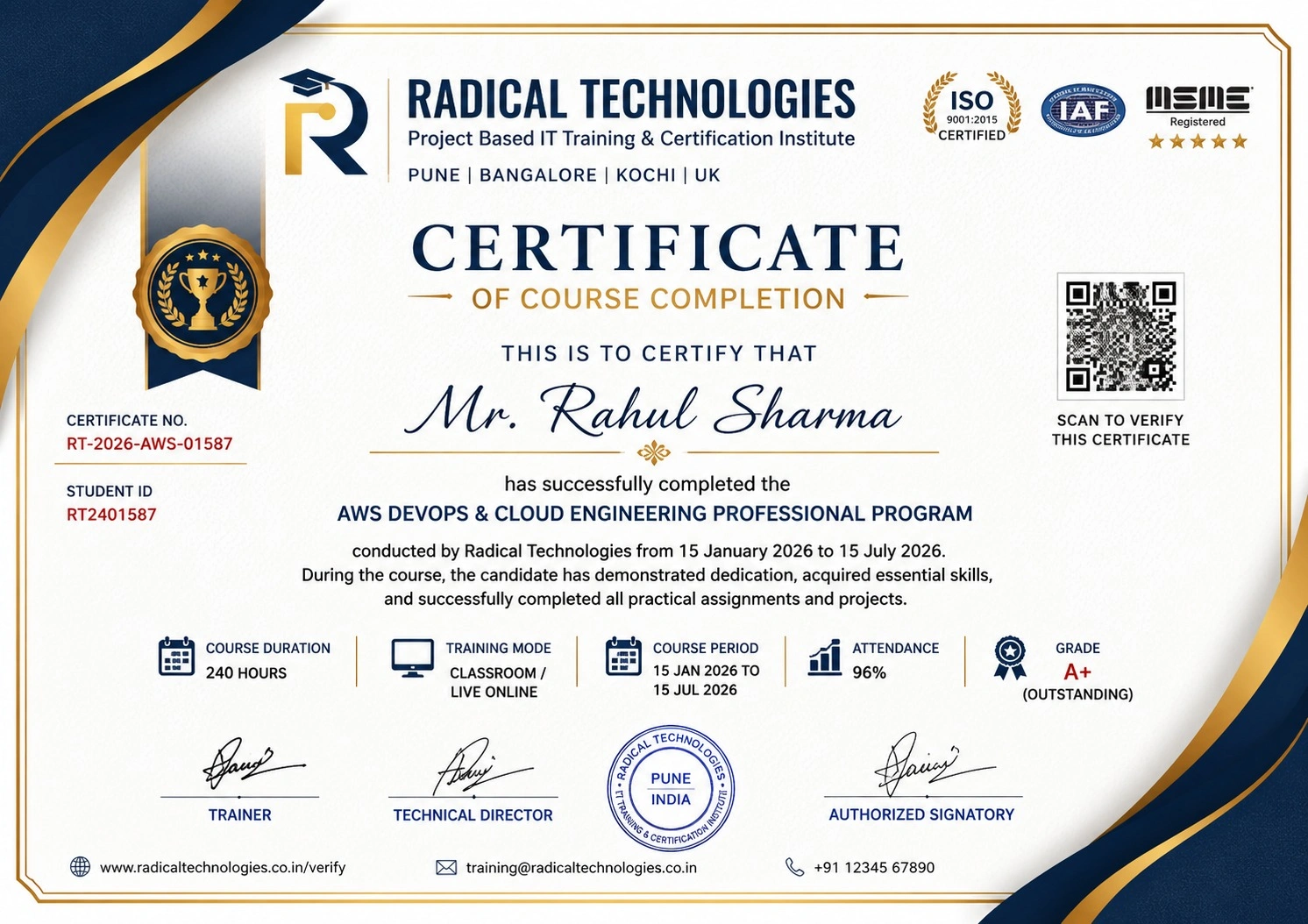
- Course Completion Certificate
- Practical Labs available
- Mentor Support available
- Doubt Clearing Session available
- 10% Discounted Global Certification
Like the Curriculum? Let's Get Started
Join 50,000+ students already enrolled at Radical Technologies
Global Certification
Radical Technologies is the leading IT certification institute in Pune, offering globally recognized certifications across various domains. With expert trainers and comprehensive materials, we ensure students gain in-depth knowledge and hands-on experience to excel in their careers. Our certification programs are tailored to meet industry standards — from cloud technologies to data science — empowering individuals to stay ahead in the ever-evolving tech landscape.
Career Services
At Radical Technologies, we are committed to your success beyond the classroom. Our 100% Job Assistance program ensures that you are not only equipped with industry-relevant skills but also guided through the job placement process. With personalised resume building, interview preparation, and access to our extensive network of hiring partners, we help you take the next step confidently into your IT career.
Career Support
Join our Brush-up Session & get support until you find a job!
Get StartedRadical Learning Eco-System
Exam Simulator
Cloud SandBox
Hands-on Cloud Lab
Developer Coding Ground
Student Reviews
Course Rating
The Revit MEP Course in Bengaluru at Radical Technologies was well-structured and highly practical. The hands-on approach helped me gain real-world skills.
Enrolling in the Revit MEP Certification in Bengaluru at Radical Technologies was a game-changer for my career. The instructors are experienced and approachable.
I took the Revit MEP Online Classes in Bengaluru, and the learning experience was seamless. The live sessions and recorded content made it easy to revisit concepts.
Radical Technologies is undoubtedly the best Revit MEP Institute in Bengaluru. Their training methodology is unmatched, and they provide excellent placement support.
The Revit MEP Online Course in Bengaluru offered by Radical Technologies allowed me to learn at my own pace without compromising quality.
If you're looking for Revit MEP Classes in Bengaluru, Radical Technologies is the right choice. Their detailed curriculum and project-based training are very effective.
The Revit MEP Corporate Training in Bengaluru conducted by Radical Technologies helped our team upskill quickly and efficiently. We highly recommend them.
I joined the Revit MEP Online Training in Bengaluru, and it was worth every penny. The trainers clarified all my doubts and provided excellent resources.
Radical Technologies offers the best Revit MEP Training in Bengaluru. Their real-time project work gave me the confidence to handle complex designs.
The Revit MEP Certification in Bengaluru from Radical Technologies added tremendous value to my resume and helped me secure a better job.
The instructors at Radical Technologies make learning easy. The Revit MEP Course in Bengaluru was comprehensive and well-paced.
I was impressed by the quality of the Revit MEP Online Certification in Bengaluru. The content was industry-relevant and up-to-date.
Radical Technologies’ Revit MEP Online Course in Bengaluru is perfect for working professionals. The flexible schedule allowed me to balance work and study.
The Revit MEP Classes in Bengaluru at Radical Technologies are highly interactive. The trainers are supportive and knowledgeable.
I had a great learning experience with the Revit MEP Online Classes in Bengaluru. The trainers ensured we understood the concepts thoroughly.
Radical Technologies is the best Revit MEP Institute in Bengaluru for anyone looking to start a career in building design and modeling.
The Revit MEP Corporate Training in Bengaluru delivered by Radical Technologies exceeded our expectations. The team became much more efficient in using BIM tools.
I joined the Revit MEP Online Training in Bengaluru to upgrade my skills, and it was an excellent decision. The trainers were very patient and knowledgeable.
Thanks to the Revit MEP Course in Bengaluru at Radical Technologies, I was able to complete a live project confidently during my training period.
The Revit MEP Certification in Bengaluru from Radical Technologies opened new career opportunities for me. The placement support was very helpful.
I opted for the Revit MEP Online Course in Bengaluru, and I loved the flexibility it offered. The content delivery was smooth and detailed.
Radical Technologies provides top-notch Revit MEP Training in Bengaluru. The practical sessions gave me the confidence to handle industry challenges.
The Revit MEP Online Certification in Bengaluru I completed at Radical Technologies gave me a competitive edge in my job search.
Radical Technologies offers the best Revit MEP Classes in Bengaluru with an updated syllabus and expert trainers. Highly recommended!
I took the Revit MEP Online Classes in Bengaluru, and the experience was amazing. The trainers are industry professionals who share real-world insights.






RCDD – REGISTERED COMMUNICATIONS DISTRIBUTION DESIGNER Interview Questions
10 questions commonly asked in RCDD – REGISTERED COMMUNICATIONS DISTRIBUTION DESIGNER interviews.
- 01 What are the primary benefits of using Revit MEP in Building Information Modeling (BIM) compared to traditional CAD tools?
- 02 Can you explain the workflow for designing an HVAC system in Revit MEP, including load calculations and duct placement?
- 03 How do you perform clash detection in Revit MEP, and what steps do you take to resolve detected conflicts?
- 04 Describe the process of creating custom parametric components (families) in Revit MEP and provide an example of their practical use.
- 05 What tools in Revit MEP are used for energy analysis, and how can they help in designing sustainable building systems?
- 06 How do you manage collaboration between mechanical, electrical, and plumbing teams within a Revit MEP project?
- 07 What are the best practices for optimizing Revit MEP models to ensure smooth performance, especially in large-scale projects?
- 08 How would you use Revit MEP to design and analyze fire protection systems, including sprinkler layouts and pipe routing?
- 09 What steps would you take to ensure compliance with local building codes and standards when designing electrical systems in Revit MEP?
- 10 Can you explain how schedules and material takeoffs are generated in Revit MEP and their significance in project documentation?
RCDD – Registered Communications Distribution Designer Course Certification with Training In Pune
Radical Technologies is the leading institute in Bengaluru for comprehensive Revit MEP Training, offering industry-focused courses to help students and professionals excel in the field of Building Information Modeling (BIM). With a proven track record of delivering top-notch training, we are committed to providing unparalleled learning experiences through expert-led sessions and hands-on projects.
Our Revit MEP Course in Bengaluru is designed to equip learners with practical skills and in-depth knowledge of mechanical, electrical, and plumbing systems. We take pride in being the preferred choice for individuals seeking to advance their careers through our Revit MEP Certification in Bengaluru and placement-focused training programs.
Experienced Trainers: Our instructors are industry experts with years of hands-on experience in Revit MEP and BIM projects.
Real-World Projects: We emphasize project-based learning, ensuring our students gain practical expertise.
Placement Support: Our dedicated placement team connects you with top companies, helping you kickstart or advance your career.
Flexible Learning Options: Whether you prefer classroom sessions or online learning, we have options tailored to your needs.
At Radical Technologies, we are more than just a Revit MEP Institute in Bengaluru; we are your partners in professional growth. Join us today and take the first step towards mastering Revit MEP and excelling in the competitive AEC (Architecture, Engineering, and Construction) industry.
For more information on our Revit MEP Training in Bengaluru, contact us today!
Our Alumni Work At



























Related Courses


RCDD – REGISTERED COMMUNICATIONS DISTRIBUTION DESIGNER Course In Other Cities
Online Batches Available For These Areas
Ambegaon Budruk | Aundh | Baner | Bavdhan Khurd | Bavdhan Budruk | Balewadi | Shivajinagar | Bibvewadi | Bhugaon | Bhukum | Dhankawadi | Dhanori | Dhayari | Erandwane | Fursungi | Ghorpadi | Hadapsar | Hingne Khurd | Karve Nagar | Kalas | Katraj | Khadki | Kharadi | Kondhwa | Koregaon Park | Kothrud | Lohagaon | Manjri | Markal | Mohammed Wadi | Mundhwa | Nanded | Parvati Hill | Panmala | Pashan | Pirangut | Shivane | Sus | Undri | Vishrantwadi | Vitthalwadi | Vadgaon Khurd | Vadgaon Budruk | Vadgaon Sheri | Wagholi | Wanwadi | Warje | Yerwada | Akurdi | Bhosari | Chakan | Charholi Budruk | Chikhli | Chimbali | Chinchwad | Dapodi | Dehu Road | Dighi | Dudulgaon | Hinjawadi | Kalewadi | Kasarwadi | Maan | Moshi | Phugewadi | Pimple Gurav | Pimple Nilakh | Pimple Saudagar | Pimpri | Ravet | Rahatani | Sangvi | Talawade | Tathawade | Thergaon | Wakad
RCDD – REGISTERED COMMUNICATIONS DISTRIBUTION DESIGNER
IT Training Programme
100% placement assistance