Radical Technologies
Programming Languages
★★★★★
(2,095 ratings)  50,000+ Student

C/C++ AND EMBEDDED C PROGRAMMING

C, C++ & Embedded C Programming is a comprehensive training program designed to help learners build strong programming and embedded development skills. It covers everything from C and C++ fundamentals to advanced programming, object-oriented concepts, Embedded C, microcontrollers, hardware interfacing, communication protocols, debugging, and real-time programming. The course enables learners to develop efficient software and embedded applications through practical coding, hands-on projects, and industry-focused training.

RT
Radical Technologies
50,000+ English 50 Hours Weekdays / Weekends Classroom / Online / Corporate
Online / Classroom

C/C++ AND EMBEDDED C PROGRAMMING

IT Training Programme

Duration 50 Hours
Batch Type Weekdays / Weekends
Mode of Training Classroom / Online / Corporate
Locations Pune, Bangalore, Kochi
Language English
Certification Globally Recognized
Call Now

100% placement assistance

Enquire Now

Get course fees, batch dates & a callback

We never share your details.

What you'll learn

Understand core concepts and architecture from the ground up
Get hands-on with the tools used by working professionals
Build real-world projects you can add to your portfolio
Learn industry best practices and coding standards
Practice with real datasets and real-world scenarios
Prepare for certification and technical interviews
Work on collaborative, team-based exercises
Apply performance tuning and optimization techniques
Understand how the technology fits into a larger ecosystem
Complete assignments reviewed by mentors

Programme Overview

37 sections covering the complete curriculum — a single, progressive learning arc.

50 Hours
Training Duration
37
Core Modules
759
Total Lessons
4.7★
Average Rating
50K+
Students Trained
01

Foundations & Core Concepts

Get hands-on with the fundamentals and architecture — the building blocks for everything that follows.

Fundamentals Architecture Setup
02

Hands-On Practical Training

Work through real exercises and assignments designed to mirror what you will do on the job.

Practicals Assignments Labs
03

Real-World Projects

Apply what you have learned to end-to-end projects that go straight into your portfolio.

Projects Portfolio Case Studies
04

Advanced Techniques

Go beyond the basics with advanced concepts, integrations and production-grade practices.

Advanced Integration Best Practices
05

Ecosystem Integration

Understand how this technology connects with the broader tools and platforms used in the industry.

Ecosystem Tools Platforms
06

Performance & Interview Prep

Master optimization techniques and prepare for the technical interview questions employers actually ask.

Optimization Interview Prep Certification

Who is this programme for?

Whether you're already writing code, working with data, or supporting applications today — this programme is built to take you into a Programming Languages role.

Software Developers

Engineers who want to add this skill set to their toolkit

Analysts & Consultants

Professionals moving into a more technical, hands-on role

IT Professionals

System admins and support engineers upskilling into a new domain

Fresh Graduates

CS/IT graduates aiming for a job-ready technical role

Course Curriculum

37 sections  •  759 lessons  •  50 Hours

01 Course Overview
This program is designed as a job-oriented C, C++ and Embedded C training program, progressing from programming fundamentals to advanced software development and microcontroller-based embedded systems.

The training covers:

C Programming → Advanced C → C++ → OOP → STL → Modern C++ → Embedded C → Microcontrollers → GPIO → Timers → Interrupts → UART/SPI/I2C → ADC/PWM → RTOS Fundamentals → Embedded Debugging → Embedded Projects

The program emphasizes hands-on coding, debugging, hardware interaction, real-time programming, memory management, device communication and industry-oriented projects.

Target Job Roles

Embedded C Developer
Embedded Software Engineer
Firmware Developer
C/C++ Developer
Software Engineer – C/C++
Automotive Embedded Developer
IoT Embedded Developer
Microcontroller Developer
BSP Developer – Entry Level
Device Driver Developer – Entry Level
Embedded Test Engineer
Firmware Validation Engineer
02 Prerequisites

Basic Prerequisites

Basic computer knowledge
Basic mathematics and logical reasoning
Understanding of operating systems is beneficial
Basic electronics knowledge is beneficial for the Embedded C portion

Recommended

Engineering/Diploma in Electronics, Electrical, Computer Science, IT or related field
Basic digital electronics knowledge
Basic understanding of binary and hexadecimal numbers

No prior programming experience is mandatory.

03 Fundamentals

Programming Fundamentals

Programming concepts
Algorithms
Flowcharts
Pseudocode
Compiler vs Interpreter
Source code, object code and executable
Variables
Constants
Data types
Operators
Expressions
Input/output
Type conversion
Conditional statements
Loops
Functions
Debugging fundamentals

Computer & Memory Fundamentals

Binary numbers
Hexadecimal numbers
Bits and bytes
Memory concepts
Stack
Heap
Registers
RAM
ROM/Flash
CPU fundamentals
Memory addressing
04 4. Core Technical Topics – C Programming

Module 1 – C Programming Basics

C language introduction
C program structure
Compilation process
main()
Variables and constants
Data types
Keywords
Identifiers
Operators
Expressions
Type casting
Standard input/output

Control Statements

if
if-else
Nested if
switch-case
for loop
while loop
do-while
break
continue
goto
05 Functions & Modular Programming
Function declaration
Function definition
Function calling
Parameters
Return values
Call by value
Recursion
Scope
Lifetime
Storage classes
Static functions
Modular programming
Header files
Multiple source files
06 Arrays & Strings

Arrays

One-dimensional arrays
Two-dimensional arrays
Multidimensional arrays
Array traversal
Searching
Sorting
Matrix operations

Strings

Character arrays
String handling
String functions
String comparison
String searching
String manipulation
String parsing
07 Pointers – Advanced C
Pointer fundamentals
Address operator
Dereferencing
Pointer arithmetic
Pointer to pointer
Array pointers
Pointer and arrays
Pointer and strings
Function pointers
Callback functions
Pointers to structures
Dynamic memory
NULL pointers
Dangling pointers
Wild pointers
Memory leaks
08 Structures, Unions & Enumerations
Structures
Nested structures
Array of structures
Pointers to structures
Structures and functions
Typedef
Unions
Enumerations
Bit-fields
Packed structures
Memory alignment
Padding
09 Dynamic Memory Management
malloc()
calloc()
realloc()
free()
Heap management
Memory allocation strategies
Memory leaks
Double free
Use-after-free
Memory corruption
Defensive programming
10 Advanced C
Preprocessor
Macros
Conditional compilation
Header guards
#define
#include
#ifdef
#ifndef
#pragma
Command-line arguments
File handling
Binary files
Text files
Error handling
errno
Assertions

Advanced Programming

Function pointers
Callback architecture
State machines
Finite State Machines
Circular buffers
Linked lists
Stacks
Queues
Hash tables
Bit manipulation
Bit masking
Bit shifting
11 Data Structures & Algorithms with C
Linked Lists
Doubly Linked Lists
Circular Linked Lists
Stack
Queue
Circular Queue
Binary Search
Linear Search
Bubble Sort
Selection Sort
Insertion Sort
Quick Sort
Merge Sort
Binary Trees
Hashing
Time complexity
Space complexity
12 C++ Programming

C++ Fundamentals

C vs C++
C++ program structure
Namespaces
References
Functions
Function overloading
Default arguments
Inline functions
Const correctness
auto
Type inference
Scope resolution
13 Object-Oriented Programming

OOP Concepts

Classes
Objects
Constructors
Destructors
Encapsulation
Abstraction
Inheritance
Polymorphism

Advanced OOP

Single inheritance
Multiple inheritance
Multilevel inheritance
Hierarchical inheritance
Virtual functions
Pure virtual functions
Abstract classes
Function overriding
Operator overloading
Friend functions
Friend classes
Static members
this pointer
14 Advanced C++
Templates
Function templates
Class templates
Exception handling
Namespaces
Lambda expressions
Smart pointers
RAII
Move semantics
Rvalue references
Copy constructor
Move constructor
Copy assignment
Move assignment
Rule of 3
Rule of 5
Rule of 0
15 STL – Standard Template Library

Containers

vector
list
deque
stack
queue
priority_queue
set
multiset
map
multimap
unordered_map
unordered_set

Algorithms

sort
find
search
reverse
count
transform
accumulate

Iterators

Iterator concepts
Iterator categories
Iterator operations

Modern C++

unique_ptr
shared_ptr
weak_ptr
Lambda functions
constexpr
nullptr
Structured bindings
Range-based loops
std::thread
std::mutex
std::future
16 Modern C++ for Embedded/Systems Development
C++11/14/17 concepts
Zero-cost abstractions
RAII in embedded systems
Memory-efficient C++
Embedded-friendly STL
Smart pointer considerations
Exception-free programming
Static allocation
Compile-time programming
Templates for embedded systems
Object-oriented firmware architecture
C++ driver abstraction
17 Embedded Systems Fundamentals
Embedded system architecture
Microcontroller vs microprocessor
MCU architecture
CPU
ALU
Registers
Memory
Flash
SRAM
EEPROM
Clock systems
Reset systems
Boot process
Watchdog timer
Low-power concepts
Real-time systems
Bare-metal programming
18 Embedded C

Embedded C Fundamentals

Embedded C vs Standard C
Microcontroller programming
Hardware registers
Memory-mapped I/O
Volatile keyword
Const and volatile
Bit manipulation
Bit masking
Register configuration
Peripheral access
Startup code concepts
Linker concepts
Interrupt vector table

Important Embedded C Concepts

volatile
static
const
extern
Bit-fields
Bitwise operators
Memory alignment
Endianness
Register-level programming
19 Microcontroller Programming

Training can use platforms such as:

ARM Cortex-M
STM32
ESP32
Arduino-class microcontrollers
PIC/AVR concepts

GPIO

Digital input
Digital output
Pull-up
Pull-down
LED control
Button interfacing
Debouncing

Timers

Timer configuration
Counter
Prescaler
Timer interrupts
Input capture
Output compare
20 Interrupts
Interrupt fundamentals
Hardware interrupts
Software interrupts
Interrupt vectors
ISR
Interrupt priority
Nested interrupts
Interrupt latency
Critical sections
Interrupt-safe programming
ISR best practices
21 UART / SPI / I2C

UART

Serial communication
Baud rate
TX/RX
UART configuration
Interrupt-based UART
UART debugging

SPI

Master/slave
Clock polarity
Clock phase
Chip select
Full duplex
SPI sensor communication

I2C

SDA/SCL
Addressing
Master/slave
ACK/NACK
EEPROM communication
Sensor communication
22 ADC, DAC & PWM

ADC

Analog vs digital signals
ADC resolution
Sampling
ADC configuration
Sensor interfacing
Temperature measurement

PWM

Duty cycle
Frequency
Motor speed control
LED brightness
Servo control

DAC

DAC fundamentals
Analog output
Signal generation
23 Embedded Sensors & Actuators
Temperature sensors
Light sensors
Pressure sensors
Proximity sensors
Accelerometers
Gyroscopes
Ultrasonic sensors
OLED/LCD displays
LEDs
Motors
Relays
Buzzers
Servo motors
24 RTOS Fundamentals
RTOS concepts
Real-time systems
Tasks
Threads
Scheduling
Context switching
Priority
Preemptive scheduling
Cooperative scheduling
Semaphores
Mutex
Message queues
Event flags
Software timers
Task synchronization
Inter-task communication
Deadlocks
Priority inversion

RTOS Exposure

FreeRTOS concepts
Task creation
Task scheduling
Queues
Semaphores
Mutex
Timers
Interrupt-to-task communication
25 Embedded Linux – Introduction
Embedded Linux architecture
Boot process
Linux kernel basics
Device tree concepts
Cross compilation
Shell fundamentals
GPIO from Linux
Serial communication
Embedded Linux development workflow
Basic driver concepts
26 Device Driver Fundamentals
Device driver architecture
Character devices
Device files
Driver/kernel communication
Interrupt handling concepts
GPIO drivers
I2C drivers
SPI drivers
Driver debugging fundamentals
27 Embedded Debugging
Debugging methodology
Breakpoints
Watchpoints
Register inspection
Memory inspection
Stack analysis
Core dumps
Fault handling
HardFault analysis
BusFault
UsageFault
Watchdog debugging
Race conditions
Timing issues
Memory corruption
28 Hands-On Labs

C Labs

C Programming Fundamentals Lab
Control Flow & Loop Programming Lab
Functions & Recursion Lab
Array & Matrix Processing Lab
String Processing Lab
Pointer Programming Lab
Dynamic Memory Management Lab
Structures & Unions Lab
Bit Manipulation Lab
File Handling Lab
Linked List Implementation Lab
Stack & Queue Implementation Lab
Sorting & Searching Algorithms Lab
Function Pointer & Callback Lab
Finite State Machine Lab

C++ Labs

C++ Fundamentals Lab
Class & Object Lab
Inheritance & Polymorphism Lab
Operator Overloading Lab
Template Programming Lab
Exception Handling Lab
STL Containers Lab
STL Algorithms Lab
Smart Pointer Lab
Multithreading Lab
Modern C++ Programming Lab

Embedded C Labs

Microcontroller GPIO Lab
LED & Push Button Lab
Timer Programming Lab
Interrupt Programming Lab
UART Communication Lab
SPI Communication Lab
I2C Communication Lab
ADC Sensor Interface Lab
PWM Motor Control Lab
LCD/OLED Interface Lab
EEPROM Interface Lab
Watchdog Timer Lab
Low-Power Embedded Programming Lab
FreeRTOS Task & Scheduling Lab
RTOS Semaphore & Mutex Lab
Embedded Debugging Lab
29 Assignments
Student Management System in C
Banking System Using Structures
Employee Payroll System
Library Management System
File-Based Inventory System
String Processing Utility
Dynamic Memory Management Challenge
Linked List Implementation
Stack & Queue Implementation
Sorting Algorithm Benchmark
Function Pointer Callback Framework
Finite State Machine Assignment
C++ Banking Application
OOP Employee Management System
STL-Based Inventory Manager
Smart Pointer Memory Management
Multithreaded Producer-Consumer Program
Embedded Register Manipulation Assignment
GPIO Driver Assignment
UART Communication Assignment
I2C Sensor Communication Assignment
ADC-Based Temperature Monitoring
PWM Motor Control Assignment
Interrupt-Based Event Controller
RTOS Task Synchronization Assignment
30 Mini Projects

Mini Project 1 – Smart Digital Thermometer

Technologies:

Embedded C + ADC + Sensor + LCD

Features:

Temperature acquisition
ADC processing
LCD display
Threshold alerts
Sensor fault detection

Mini Project 2 – Password-Based Digital Lock

Technologies:

Embedded C + GPIO + Keypad + LCD

Features:

Password authentication
Lock/unlock control
Failed-attempt handling
Buzzer alarm

Mini Project 3 – Smart Motor Speed Controller

Technologies:

Embedded C + PWM + ADC

Features:

Speed control
PWM generation
Feedback monitoring
Overload handling

Mini Project 4 – UART-Based Device Monitoring System

Technologies:

C + Embedded C + UART

Features:

Sensor data transmission
Command processing
Error detection
Serial diagnostics

Mini Project 5 – RTOS-Based Sensor Monitoring

Technologies:

C/C++ + Embedded C + FreeRTOS

Features:

Multiple tasks
Sensor task
Display task
Communication task
Queue-based communication
Task synchronization
31 Capstone Projects

Capstone Project 1 – Industrial IoT Monitoring System

System

Sensors → Microcontroller → Embedded C Firmware → Communication → Monitoring Application

Features

Multiple sensor interfaces
Temperature monitoring
Humidity monitoring
ADC acquisition
GPIO control
UART/SPI/I2C communication
Alarm management
Data logging
Fault detection
Watchdog protection
RTOS-based task management

Capstone Project 2 – Automotive Embedded Control System

Build a simplified automotive controller involving:

Embedded C
GPIO
ADC
PWM
Timers
Interrupts
UART/CAN concepts
Sensor processing
Fault detection
Watchdog
State-machine architecture

Job Skills Developed

Firmware development
Hardware interfacing
Real-time programming
Debugging
Embedded architecture
Driver-level programming

Capstone Project 3 – Smart Motor Control System

Develop a complete motor-control prototype:

Sensor → MCU → Control Algorithm → PWM → Motor → Feedback

Include:

PWM
ADC
Interrupts
Timers
PID fundamentals
Fault detection
RTOS
UART diagnostics
Embedded debugging
32 Real-Time Job-Oriented Scenarios

Students practice scenarios such as:

Firmware crashes after running for several hours.
MCU resets unexpectedly.
UART communication occasionally fails.
Sensor data contains random values.
GPIO output is not switching correctly.
Interrupt is not triggering.
Timer frequency is incorrect.
I2C device is not detected.
SPI sensor returns incorrect data.
ADC readings are unstable.
PWM frequency is incorrect.
Motor suddenly stops.
Firmware consumes excessive RAM.
Stack overflow occurs.
Heap memory becomes fragmented.
Watchdog continuously resets the system.
Race condition occurs between tasks.
RTOS task misses its deadline.
Deadlock occurs between two tasks.
Firmware must support a new sensor.
Existing C code must be migrated to C++.
Legacy firmware needs modularization.
Firmware needs to reduce CPU utilization.
Boot time must be reduced.
Product requires a new communication protocol.
Firmware needs production-level logging.
Embedded system needs low-power operation.
Firmware must recover automatically from a peripheral failure.
Hardware revision requires firmware changes.
Customer reports an intermittent field failure.
33 Troubleshooting Scenarios

C/C++ Troubleshooting

Segmentation fault
Memory leak
Buffer overflow
Dangling pointer
Null pointer dereference
Stack overflow
Double free
Use-after-free
Race condition
Deadlock
Unexpected behavior from undefined behavior
Incorrect object lifetime
Copy/move-related bugs

Embedded Troubleshooting

MCU not booting
Firmware stuck in startup
HardFault
Watchdog reset
Interrupt failure
UART communication failure
I2C NACK
SPI data corruption
ADC incorrect readings
Timer mismatch
PWM instability
GPIO failure
Sensor communication failure
Memory corruption
Stack overflow
Timing violation
RTOS task starvation
Priority inversion
Power-management issue
34 Industry Tools

IDEs & Development Environments

Visual Studio
Visual Studio Code
Eclipse
STM32CubeIDE
Keil MDK
IAR Embedded Workbench
MPLAB X
Arduino IDE

Compilers & Build Tools

GCC
G++
ARM GCC
Clang/LLVM
Make
CMake
Ninja

Debugging Tools

GDB
OpenOCD
ST-LINK
J-Link
Logic Analyzer
Oscilloscope
Serial Terminal

Embedded Platforms

STM32
ARM Cortex-M
ESP32
AVR
PIC
Arduino-class boards

Version Control

Git
GitHub
GitLab
Bitbucket

Testing & Quality

GoogleTest
CppUnit
CMock
Unity Test Framework
Valgrind
AddressSanitizer
UndefinedBehaviorSanitizer
Static analysis tools
SonarQube

Automotive Exposure

CAN
CANalyzer
CANoe
Vector tools
AUTOSAR concepts
35 Best Practices
Follow MISRA C/C++ principles where applicable.
Use modular architecture.
Avoid unnecessary global variables.
Validate pointers before use.
Handle memory allocation carefully.
Prevent buffer overflows.
Use const appropriately.
Use volatile correctly for hardware/shared state.
Keep ISRs short.
Avoid blocking operations inside interrupts.
Use state machines for complex embedded logic.
Use defensive programming.
Maintain coding standards.
Use meaningful naming conventions.
Perform code reviews.
Use static analysis.
Implement unit testing.
Use version control.
Maintain traceability between requirements and tests.
Document interfaces and APIs.
Use hardware-in-the-loop testing where appropriate.
Profile memory and CPU utilization.
Design firmware for fault recovery.
36 Certification Names

Recommended C/C++ Certifications

C Programming Certification
C++ Institute C Programming / C++ Certifications
C++ Certified Associate Programmer (CPA)
C++ Certified Professional Programmer (CPP)

Embedded Certifications / Credentials

Arm Accredited Engineer / Arm-related training credentials
STMicroelectronics STM32 training/certification programs
AUTOSAR-related professional training/certifications
MISRA C/C++ training and assessment credentials

Recommended Supporting Certifications

ISTQB Certified Tester – for embedded testing career paths
Linux Foundation Embedded Linux training/certifications
AUTOSAR certifications/training for automotive specialization

For employment, however, demonstrable C/C++ coding ability + embedded projects + debugging experience is often more valuable than collecting many entry-level programming certificates.

37 Mock Interviews

Round 1 – C Programming

Pointers
Arrays
Structures
Memory management
Bit manipulation
Function pointers
Data structures

Round 2 – C++

OOP
Inheritance
Polymorphism
Virtual functions
Templates
STL
Smart pointers
Modern C++

Round 3 – Embedded C

Registers
volatile
Interrupts
Timers
GPIO
UART
SPI
I2C
ADC
PWM

Round 4 – Real-Time Scenarios

Firmware crashes
Memory corruption
Watchdog resets
Communication failures
RTOS problems
Hardware/software debugging

Round 5 – Project Interview

"Explain your architecture, your contribution, design decisions, debugging approach and how you solved production-like issues."

Final Job-Ready Skill Path

C Programming → Advanced C + Data Structures → C++ + OOP + STL → Modern C++ → Embedded C → Microcontrollers & Registers → GPIO + Timers + Interrupts → UART + SPI + I2C → ADC + PWM + Sensors → RTOS + FreeRTOS → Embedded Debugging → Capstone Firmware Project → Mock Interviews + Job Preparation

Tools & Technologies

Every tool listed here is installed, configured and used in a hands-on lab session.

Core Tools

Hands-On Labs

Practical Environment

Industry-Standard Tools

Real-World Setup

Guided Exercises

Skill Building

Sample Datasets

Practice Material

Practice & Projects

Mini Projects

Applied Practice

Assignments

Mentor Reviewed

Doubt Sessions

Live Support

Career Readiness

Resume Building

Career Support

Mock Interviews

Interview Prep

Certification Prep

Global Recognition

Deployment & Delivery

Production Practices

Real-World Ready

Best Practices

Industry Standards

759+
Hands-On Lessons
37
Core Modules
50 Hours
Training Duration
100%
Practical Training

You don't just learn C/C++ AND EMBEDDED C PROGRAMMING. You ship it.

Three major projects, each mirroring how production teams actually work — from guided foundations to a portfolio-ready capstone.

PROJECT // 01

Guided Foundation Project

→Requirement Analysis

→Guided Implementation

→Mentor Review

→Iteration

Foundation Beginner

Apply the fundamentals in a structured, mentor-reviewed project

Take the core concepts from the first half of the curriculum and apply them to a realistic scenario, with guidance and feedback from your mentor at every step.

Structured project brief
Step-by-step implementation
Mentor feedback and review
Documented outcome
Stack Core Concepts Best Practices
PROJECT // 02

Applied Practice Project

→Scenario Design

→Independent Build

→Testing & Validation

→Peer Review

Applied Intermediate

Build a more independent project mirroring real production scenarios

Work through a project that combines multiple concepts from the curriculum, closer to how work is actually structured on the job — less hand-holding, more ownership.

End-to-end implementation
Testing and validation
Documentation
Peer/mentor review
Stack Applied Skills Testing
PROJECT // 03

Capstone Project

→Planning

→End-to-End Build

→Review & Refinement

→Presentation

Capstone Advanced

Take a project from requirements to a polished, portfolio-ready deliverable

Your final project — plan, build, test and present a complete solution using everything covered in the curriculum, reviewed by mentors before you graduate.

Complete working solution
Presentation-ready documentation
Mentor sign-off
Portfolio-ready deliverable
Stack Full Curriculum Portfolio

All 3 projects go directly into your portfolio & resume — reviewed by mentors before you graduate.

See Sample Project Reports

Upcoming Batches

No upcoming batches scheduled right now. Enquire to get notified.

Why Radical Technologies

Live Online Training
  • Highly practical oriented training
  • Installation support on your system
  • 24/7 Email and Phone support
  • 100% Placement Assistance
  • Global Certification Preparation
  • Trainer-Student Interactive Portal
  • Assignments and Projects by Mentors
Live Classroom Training
  • Weekend / Weekdays / Morning / Evening batches
  • 80:20 Practical and Theory ratio
  • Real-life Case Studies
  • Easy make-up for missed sessions
  • PSI | Kryterion | Redhat Test Centers
  • Lifetime Video Classroom Access (coming soon)
  • Resume Prep and Mock Interviews
Self-Paced Training
  • Learn 300+ courses at your own time
  • 50,000+ Satisfied Learners
  • Course Completion Certificate
  • Practical Labs available
  • Mentor Support available
  • Doubt Clearing Session available
  • 10% Discounted Global Certification

Like the Curriculum? Let's Get Started

Join 50,000+ students already enrolled at Radical Technologies

Enroll Now

Global Certification

Radical Technologies is the leading IT certification institute in Pune, offering globally recognized certifications across various domains. With expert trainers and comprehensive materials, we ensure students gain in-depth knowledge and hands-on experience to excel in their careers. Our certification programs are tailored to meet industry standards — from cloud technologies to data science — empowering individuals to stay ahead in the ever-evolving tech landscape.
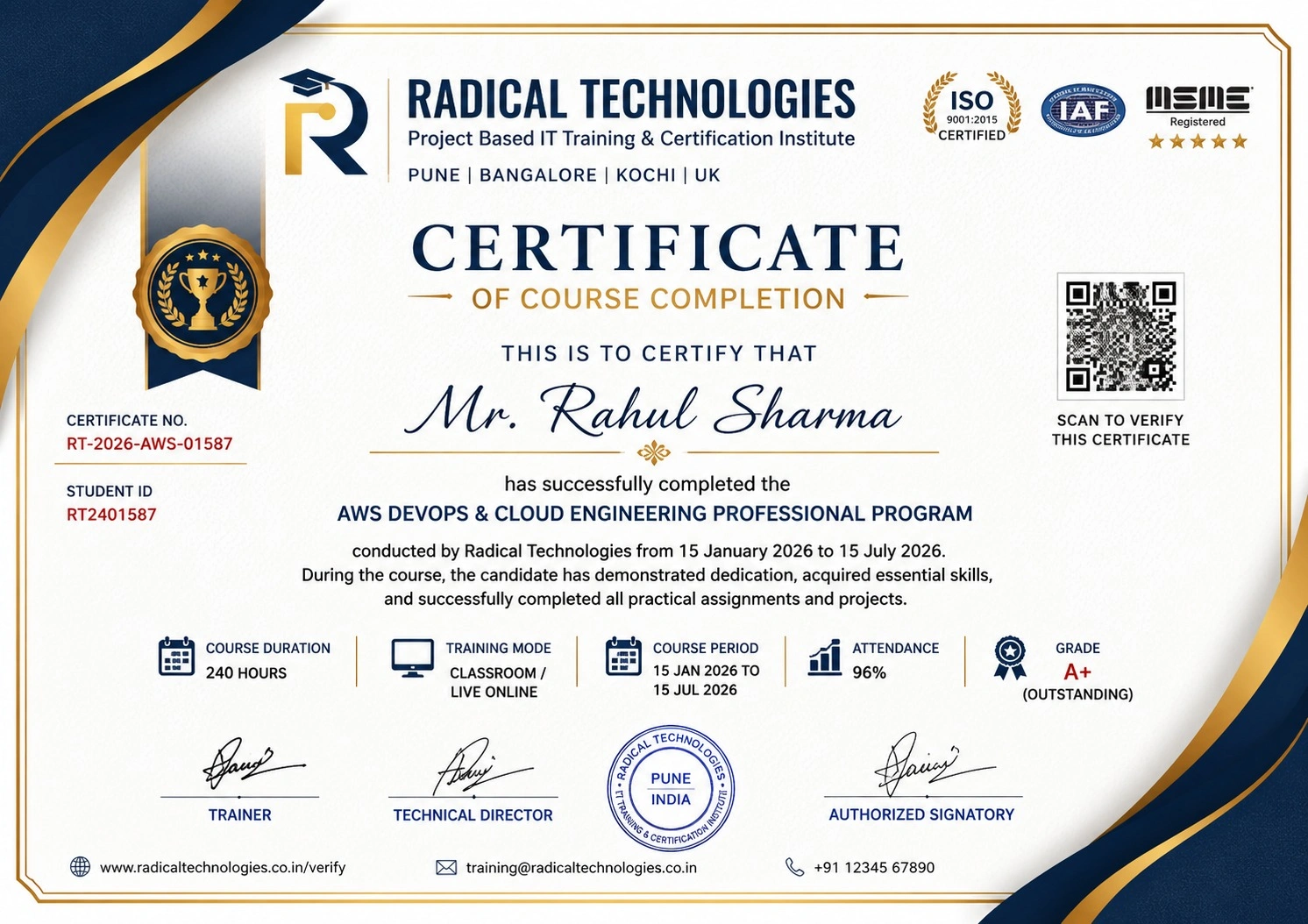
Certificate of Completion

Career Services

At Radical Technologies, we are committed to your success beyond the classroom. Our 100% Job Assistance program ensures that you are not only equipped with industry-relevant skills but also guided through the job placement process. With personalised resume building, interview preparation, and access to our extensive network of hiring partners, we help you take the next step confidently into your IT career.

Career Support

Course Completed? Need next steps?
Need Interview Supports?
Need Job Assistance?
Came from any other Institute?

Join our Brush-up Session & get support until you find a job!

Get Started

Radical Learning Eco-System

Exam Simulator

Cloud SandBox

Hands-on Cloud Lab

Developer Coding Ground

Student Reviews

4.7★
Average learner rating
50K+
Students trained
30+
Hiring companies alumni work at
100%
Placement assistance
4.7
★★★★★

Course Rating

★★★★★
79%
★★★★☆
16%
★★★☆☆
3%
★★☆☆☆
1%
★☆☆☆☆
1%

C/C++ And Embedded C Programming Course Certification with Online Training in Pune [UPDATED]

C, C++ & Embedded C Training Course is a job-oriented program designed to build strong programming skills from fundamentals to advanced development. The course covers C Programming, Advanced C, C++, OOP, STL, Modern C++, Embedded C, Microcontrollers, GPIO, Timers, Interrupts, UART, SPI, I2C, ADC, PWM, RTOS fundamentals, debugging, and embedded projects.

Learners gain practical experience in coding, memory management, debugging, hardware interaction, device communication, and real-time programming through hands-on training and industry-oriented projects.

This course is ideal for students, beginners, C/C++ developers, software engineers, and aspiring Embedded C, Firmware, IoT, and Automotive Embedded professionals looking to build practical skills for embedded and software development careers.

Our Alumni Work At

Accenture
Amazon
Avisys Services
Birlasoft
Capgemini
Catchpoint
Cognizant
Darwish Cybertech
DataVision
GiBots
Google
Groots Software
HCL Technologies
IBM
Info Gain
Infosys
ITCube Solutions
KPIT
L&T Infotech
Microsoft
Mphasis
mPhatek
Oracle
Quantbit Technologies
Saina Cloud
TCS
Tech Mahindra
Wipro
YASH Technologies
Zensar Technologies
Accenture
Amazon
Avisys Services
Birlasoft
Capgemini
Catchpoint
Cognizant
Darwish Cybertech
DataVision
GiBots
Google
Groots Software
HCL Technologies
IBM
Info Gain
Infosys
ITCube Solutions
KPIT
L&T Infotech
Microsoft
Mphasis
mPhatek
Oracle
Quantbit Technologies
Saina Cloud
TCS
Tech Mahindra
Wipro
YASH Technologies
Zensar Technologies

Get a Call Back from Our Career Assistance Team

Request Callback