0
+
Google Reviews
0
+
4.5 (2679 Ratings)
The Microsoft SC-200: Security Operations Analyst course is designed for professionals who want to detect, investigate, and respond to cybersecurity threats using Microsoft security technologies. The training covers Microsoft Sentinel, Microsoft Defender XDR, threat detection, incident response, security monitoring, threat hunting, vulnerability management, and security automation through hands-on labs and real-world scenarios. Students learn how to analyze security events, investigate incidents, and protect enterprise environments from evolving cyber threats. As cybersecurity continues to be a top priority for organizations, this course is ideal for security analysts, SOC analysts, cybersecurity professionals, system administrators, cloud security engineers, and IT professionals looking to build expertise in Microsoft security operations.
Duration of Training : 32 Hours
Batch type : Weekdays/Weekends
Mode of Training : Classroom/Online/Corporate Training
Detailed Syllabus • Hands-on Labs • Assignments • Support-Focused • Implementation
Curriculum Designed by Experts
The Microsoft SC-200: Security Operations Analyst course is designed for aspiring SOC Analysts, Security Engineers, Cybersecurity Professionals, Cloud Security Engineers, and IT Administrators who want to build expertise in threat detection, incident response, security monitoring, and threat hunting using Microsoft Security technologies.
This course focuses on Microsoft Defender XDR, Microsoft Sentinel (SIEM & SOAR), Microsoft Defender for Endpoint, Defender for Identity, Defender for Office 365, Microsoft Entra ID, Kusto Query Language (KQL), threat intelligence, and security automation through real-world SOC environments.
Understand the Microsoft Security Ecosystem
Configure and Manage Microsoft Sentinel
Investigate Security Incidents using Microsoft Defender XDR
Perform Threat Hunting with KQL
Detect and Respond to Cyber Threats
Automate Security Operations using Playbooks
Analyze Security Logs and Alerts
Implement Threat Intelligence
Become Job-Ready as a SOC Analyst
Basic Computer Knowledge
Windows Administration Fundamentals
Basic Networking (TCP/IP, DNS, DHCP)
Basic Microsoft Azure Concepts
Microsoft Entra ID Fundamentals
Basic Cybersecurity Concepts
Understanding of Firewalls and Endpoint Security
Basic Cloud Computing Knowledge
Basic PowerShell Knowledge (Recommended)
SC-900 or AZ-900 Knowledge (Recommended but Not Mandatory)
Introduction to Cyber Security
Security Operations Center (SOC)
Blue Team Fundamentals
Microsoft Security Architecture
Microsoft Defender Suite
Microsoft Sentinel Overview
SIEM vs SOAR
Threat Intelligence
Cyber Kill Chain
MITRE ATT&CK Framework
Zero Trust Security
Microsoft Entra ID Security
Security Compliance Basics
Identity Protection
Endpoint Security Fundamentals
Core Technical Topics (Main Syllabus)
Microsoft Security Portfolio
Microsoft Defender XDR
Microsoft Sentinel Architecture
Zero Trust Model
Microsoft Entra ID Security
Microsoft Purview Overview
Microsoft Defender Portal
Security Operations Lifecycle
Security Incident Lifecycle
Microsoft Security Best Practices
Defender XDR Architecture
Defender Portal Navigation
Incident Queue
Alert Management
Device Inventory
User Investigation
Attack Timeline
Threat Analytics
Automated Investigation
Response Actions
Endpoint Protection
Endpoint Detection & Response (EDR)
Device Risk Assessment
Vulnerability Management
Live Response
Device Isolation
Malware Investigation
Attack Surface Reduction
Security Recommendations
Endpoint Compliance
Identity Protection
Active Directory Monitoring
Lateral Movement Detection
Credential Theft Detection
Identity Risk Investigation
Privileged User Monitoring
Insider Threat Detection
Hybrid Identity Security
Identity Alerts
Identity Investigation
Email Security
Anti-Phishing Policies
Safe Links
Safe Attachments
Malware Protection
Threat Explorer
Email Investigation
Exchange Protection
User Reported Messages
Office Security Reports
Sentinel Architecture
Workspace Configuration
Data Connectors
Log Collection
Analytics Rules
Hunting Queries
Workbooks
Watchlists
Threat Intelligence Integration
Incident Management
Automation Rules
Logic Apps Playbooks
SOAR Automation
Incident Response
Security Dashboards
KQL Fundamentals
Filtering
Sorting
Aggregations
Parsing Logs
Time Series Analysis
Joins
Hunting Queries
Performance Optimization
Advanced KQL
Threat Hunting Methodology
IOC Analysis
Malware Investigation
Suspicious Login Detection
Endpoint Investigation
Email Investigation
Insider Threat Hunting
Cloud Threat Hunting
Behavioral Analytics
Threat Intelligence Integration
Incident Creation
Alert Correlation
Investigation Process
Evidence Collection
Containment
Eradication
Recovery
Root Cause Analysis
Reporting
Lessons Learned
Automation Rules
Playbooks
Logic Apps
Automated Response
Alert Suppression
Ticket Creation
Email Notifications
Teams Integration
Incident Escalation
SOC Automation
Dashboard Creation
Workbook Design
Alert Monitoring
Security KPIs
Compliance Reports
Threat Intelligence Reports
Log Analytics
Security Health Monitoring
SOC Metrics
Executive Reporting
Configure Microsoft Sentinel Workspace
Connect Data Sources
Configure Microsoft Defender XDR
Deploy Defender for Endpoint
Configure Defender for Identity
Configure Defender for Office 365
Create Analytics Rules
Write KQL Hunting Queries
Investigate Security Incidents
Isolate Compromised Devices
Configure Automation Rules
Build Logic Apps Playbooks
Create Sentinel Workbooks
Import Threat Intelligence Feeds
Simulate Phishing Attack Investigation
Perform Malware Investigation
Generate Security Reports
Execute Incident Response Workflow
Configure Microsoft Sentinel Environment
Build Custom Analytics Rules
Write KQL Queries for Threat Hunting
Investigate Security Incidents
Configure Defender Security Policies
Design SOC Dashboard
Create Threat Intelligence Report
Develop Automation Playbook
Document Incident Response Process
Perform Security Health Assessment
Microsoft Sentinel SIEM Deployment
Enterprise SOC Dashboard Implementation
Microsoft Defender XDR Security Monitoring
Automated Incident Response Solution
Threat Hunting using KQL
Security Monitoring for Hybrid Environment
Project 1
Enterprise Security Operations Center (SOC) using Microsoft Sentinel
Project 2
End-to-End Threat Detection and Incident Response using Microsoft Defender XDR
Project 3
Automated Security Operations using Microsoft Sentinel SOAR Playbooks
Project 4
Threat Hunting and Security Monitoring for Hybrid Cloud Infrastructure
Investigate suspicious login activities.
Analyze phishing email incidents.
Respond to ransomware alerts.
Isolate compromised endpoints.
Configure Sentinel analytics for new threats.
Perform proactive threat hunting using KQL.
Correlate alerts from multiple Microsoft Defender products.
Integrate third-party firewall logs into Sentinel.
Build SOC dashboards for management reporting.
Automate repetitive SOC tasks using Logic Apps.
Conduct root cause analysis after security incidents.
Prepare executive incident reports and remediation plans.
Sentinel data connector not collecting logs.
Defender for Endpoint agent not reporting.
Missing or delayed security alerts.
KQL query returning incorrect results.
Playbook automation failures.
Logic Apps execution issues.
False-positive alert tuning.
Threat intelligence feed synchronization issues.
Defender portal communication problems.
Endpoint isolation failures.
Email security policy misconfigurations.
Incident duplication and alert correlation issues.
Microsoft Sentinel
Microsoft Defender XDR
Microsoft Defender for Endpoint
Microsoft Defender for Identity
Microsoft Defender for Office 365
Microsoft Entra ID
Azure Monitor
Azure Log Analytics
Kusto Query Language (KQL)
Microsoft Logic Apps
Microsoft Security Copilot (Overview)
Microsoft Intune (Integration)
Microsoft Purview (Overview)
Wireshark
Sysinternals Suite
ServiceNow
Jira
Microsoft Teams
Microsoft Excel
Microsoft Vision
Implement a Zero Trust security model.
Enable Multi-Factor Authentication (MFA) across all user accounts.
Regularly update analytics rules and threat intelligence feeds.
Minimize false positives by tuning alert rules.
Automate repetitive SOC tasks using Logic Apps.
Conduct proactive threat hunting on a scheduled basis.
Follow structured incident response procedures.
Maintain detailed security documentation and runbooks.
Monitor security posture continuously using dashboards.
Perform regular security assessments and tabletop exercises.
Recommended certification path:
Microsoft Certified: Security Operations Analyst Associate (SC-200)
Microsoft Certified: Security, Compliance, and Identity Fundamentals (SC-900)
(Recommended)
Microsoft Certified: Identity and Access Administrator Associate (SC-300)
Microsoft Certified: Azure Security Engineer Associate (AZ-500)
Microsoft Certified: Cybersecurity Architect Expert (SC-100) (Advanced)
Our mock interview program is designed to simulate recruitment processes followed by Microsoft partners, Security Operations Centers (SOCs), Managed Security Service Providers (MSSPs), consulting firms, and enterprise cybersecurity teams.
Phase 1: Technical Assessment
Microsoft Defender XDR concepts
Microsoft Sentinel architecture
SIEM & SOAR fundamentals
KQL query writing
Incident response lifecycle
Threat intelligence and MITRE ATT&CK
Phase 2: Scenario-Based Interview
Candidates solve real-world SOC scenarios involving:
Phishing investigations
Malware outbreak analysis
Ransomware incident response
Threat hunting using KQL
Alert tuning and correlation
Automated incident response using Logic Apps
Phase 3: Practical SOC Round
Configure Sentinel analytics rules.
Investigate security incidents.
Write KQL hunting queries.
Build automation playbooks.
Present findings with remediation recommendations.
Phase 4: HR & Communication Round
Professional self-introduction.
Project presentation.
Client and stakeholder communication.
Behavioral interview questions.
Salary negotiation guidance.
Every participant receives personalized feedback, technical improvement recommendations,and repeated mock interview sessions until they are interview-ready.
Our resume preparation program is customized for SOC Analyst, Security Operations Analyst, Cybersecurity Analyst, Cloud Security Engineer, and Microsoft Security Engineer roles.
Resume Preparation Includes
Building an ATS-friendly cybersecurity resume.
Highlighting Microsoft Sentinel, Defender XDR, and KQL expertise.
Showcasing SOC projects, incident response exercises, and threat hunting experience.
Optimizing resumes with recruiter-focused security keywords.
Creating a professional LinkedIn profile.
Conducting one-on-one resume reviews with multiple revisions and interview-focused
improvements.
Our placement assistance program prepares candidates for opportunities with Microsoft partners, cybersecurity consulting firms, Managed Security Service Providers (MSSPs), cloud service providers, global system integrators, banking organizations, healthcare enterprises, and Fortune 500 companies.
Placement Support Includes
Career counseling and cybersecurity skill-gap analysis.
Hands-on SOC labs and enterprise security projects.
Resume and LinkedIn profile optimization.
Technical, managerial, and HR mock interviews.
Communication and presentation skill enhancement.
Regular interview scheduling through our network of 850+ hiring partners.
Guidance on certification planning, interview follow-ups, offer evaluation, and salary negotiation.
Continued placement assistance until candidates secure suitable employment, subject to individual performance, market conditions, and employer hiring requirements.
Course completion certificate and Global Certifications are part of our all Master Program
REVIT ARCHITECTURE / REVIT MEP Course Training empowers you with cutting-edge skills in BIM modeling, 3D design, and efficient project coordination. Master the art of creating detailed architectural plans, MEP systems, and collaborative workflows. Enroll today to enhance your expertise, boost your productivity, and advance your career in the ever-growing design and construction industry!
REVIT ARCHITECTURE / REVIT MEP Course Training paves the way for careers in architecture, MEP design, and BIM coordination. Secure roles like BIM expert, draftsman, or project manager in leading firms. Gain expertise in design, analysis, and project execution. Enroll now to thrive in the booming construction industry and unlock endless career possibilities!
REVIT ARCHITECTURE / REVIT MEP Course Training integrates cloud adoption to revolutionize design workflows. With cloud-based BIM, experience seamless collaboration, secure data sharing, and real-time updates. Learn to manage projects remotely, improve productivity, and streamline operations. Enroll now to gain expertise in cloud technology and excel in the dynamic construction and design industry!
Unlock the potential of scalability and flexibility with REVIT ARCHITECTURE / REVIT MEP course training. Learn to design with precision, streamline workflows, and handle complex projects efficiently. Master Revit’s powerful BIM tools, enhance career prospects, and stay ahead in the dynamic AEC industry!
Excel in cost management with REVIT ARCHITECTURE / REVIT MEP course training. Master budgeting, reduce resource waste, and streamline processes using Revit’s advanced BIM tools. Gain hands-on expertise to manage project costs effectively, boost efficiency, and build a competitive edge in your AEC career!
Ensure security and compliance with REVIT ARCHITECTURE / REVIT MEP course training. Learn to manage sensitive project data, adhere to industry standards, and implement best practices in BIM workflows. Gain essential skills to deliver reliable, compliant designs in today’s regulated AEC environment!
Radical Technologies is the leading IT certification institute in Pune, offering a wide range of globally recognized certifications across various domains. With expert trainers and comprehensive course materials, it ensures that students gain in-depth knowledge and hands-on experience to excel in their careers. The institute’s certification programs are tailored to meet industry standards, helping professionals enhance their skillsets and boost their career prospects. From cloud technologies to data science, Radical Technologies covers it all, empowering individuals to stay ahead in the ever-evolving tech landscape. Achieve your professional goals with certifications that matter.
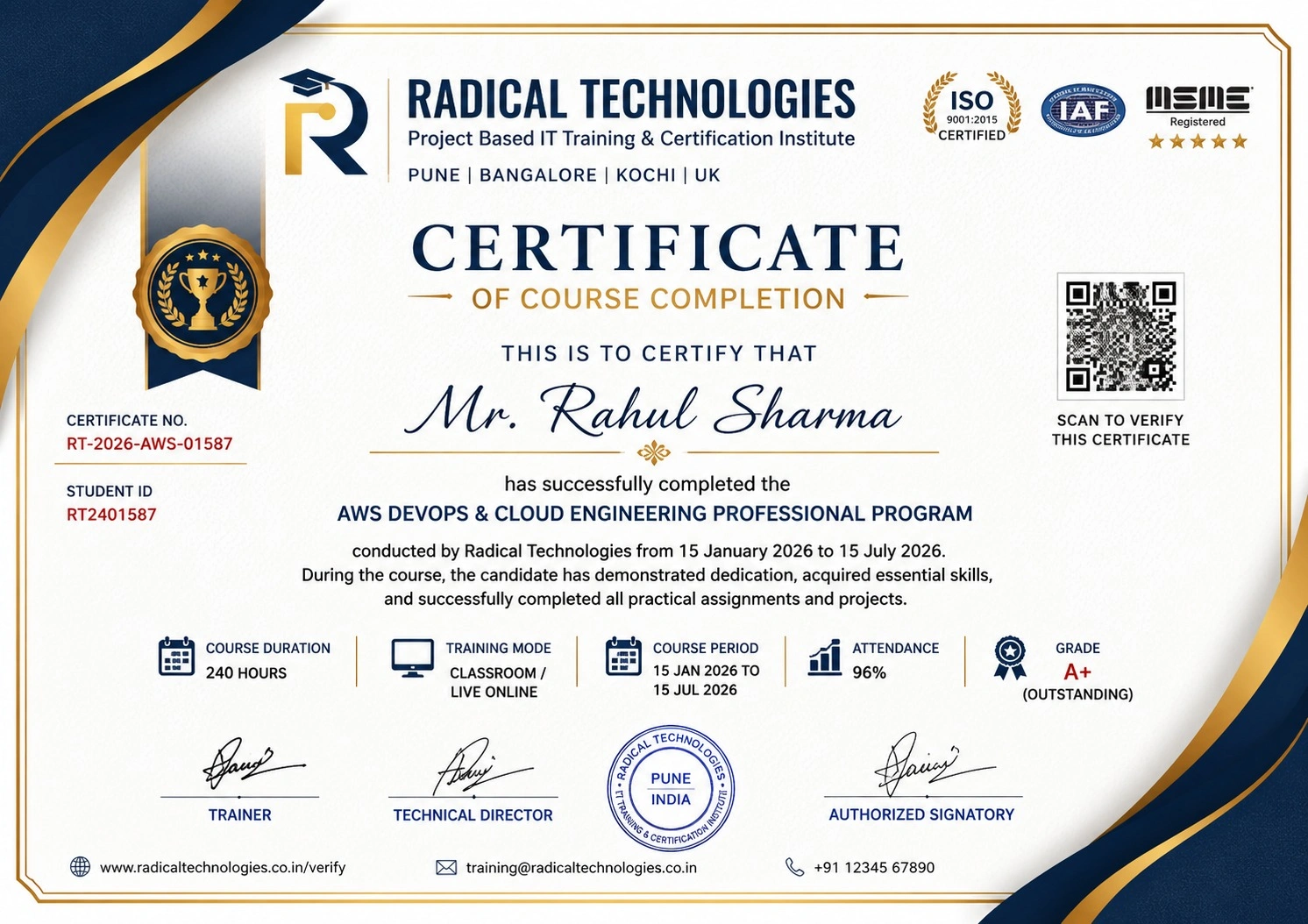
At Radical Technologies, we are committed to your success beyond the classroom. Our 100% Job Assistance program ensures that you are not only equipped with industry-relevant skills but also guided through the job placement process. With personalized resume building, interview preparation, and access to our extensive network of hiring partners, we help you take the next step confidently into your IT career. Join us and let your journey to a successful future begin with the right support.
At Radical Technologies, we ensure you’re ready to shine in any interview. Our comprehensive Interview Preparation program includes mock interviews, expert feedback, and tailored coaching sessions to build your confidence. Learn how to effectively communicate your skills, handle technical questions, and make a lasting impression on potential employers. With our guidance, you’ll walk into your interviews prepared and poised for success.
At Radical Technologies, we believe that a strong professional profile is key to standing out in the competitive IT industry. Our Profile Building services are designed to highlight your unique skills and experiences, crafting a resume and LinkedIn profile that resonate with employers. From tailored advice on showcasing your strengths to tips on optimizing your online presence, we provide the tools you need to make a lasting impression. Let us help you build a profile that opens doors to your dream career.
Infrastructure Provisioning
Implementing automated infrastructure provisioning and configuration management using Ansible. This may include setting up servers, networking devices, and other infrastructure components using playbooks and roles.
Applications Deployment
Automating the deployment and orchestration of applications across development, testing, and production environments. This could involve deploying web servers, databases. middleware, and other application components using Ansible
Continuous Integration
Integrating Ansible into CI/CD pipelines to automate software. build, test, and deployment processes. This may include automating the creation of build artifacts, running tests, and deploying applications to various environments.
The Revit MEP Course in Bengaluru at Radical Technologies was well-structured and highly practical. The hands-on approach helped me gain real-world skills.
Enrolling in the Revit MEP Certification in Bengaluru at Radical Technologies was a game-changer for my career. The instructors are experienced and approachable.
I took the Revit MEP Online Classes in Bengaluru, and the learning experience was seamless. The live sessions and recorded content made it easy to revisit concepts.
Radical Technologies is undoubtedly the best Revit MEP Institute in Bengaluru. Their training methodology is unmatched, and they provide excellent placement support.
The Revit MEP Online Course in Bengaluru offered by Radical Technologies allowed me to learn at my own pace without compromising quality.
If you're looking for Revit MEP Classes in Bengaluru, Radical Technologies is the right choice. Their detailed curriculum and project-based training are very effective.
The Revit MEP Corporate Training in Bengaluru conducted by Radical Technologies helped our team upskill quickly and efficiently. We highly recommend them.
I joined the Revit MEP Online Training in Bengaluru, and it was worth every penny. The trainers clarified all my doubts and provided excellent resources.
Radical Technologies offers the best Revit MEP Training in Bengaluru. Their real-time project work gave me the confidence to handle complex designs.
The Revit MEP Certification in Bengaluru from Radical Technologies added tremendous value to my resume and helped me secure a better job.
The instructors at Radical Technologies make learning easy. The Revit MEP Course in Bengaluru was comprehensive and well-paced.
I was impressed by the quality of the Revit MEP Online Certification in Bengaluru. The content was industry-relevant and up-to-date.
Radical Technologies’ Revit MEP Online Course in Bengaluru is perfect for working professionals. The flexible schedule allowed me to balance work and study.
The Revit MEP Classes in Bengaluru at Radical Technologies are highly interactive. The trainers are supportive and knowledgeable.
I had a great learning experience with the Revit MEP Online Classes in Bengaluru. The trainers ensured we understood the concepts thoroughly.
Radical Technologies is the best Revit MEP Institute in Bengaluru for anyone looking to start a career in building design and modeling.
The Revit MEP Corporate Training in Bengaluru delivered by Radical Technologies exceeded our expectations. The team became much more efficient in using BIM tools.
I joined the Revit MEP Online Training in Bengaluru to upgrade my skills, and it was an excellent decision. The trainers were very patient and knowledgeable.
Thanks to the Revit MEP Course in Bengaluru at Radical Technologies, I was able to complete a live project confidently during my training period.
The Revit MEP Certification in Bengaluru from Radical Technologies opened new career opportunities for me. The placement support was very helpful.
I opted for the Revit MEP Online Course in Bengaluru, and I loved the flexibility it offered. The content delivery was smooth and detailed.
Radical Technologies provides top-notch Revit MEP Training in Bengaluru. The practical sessions gave me the confidence to handle industry challenges.
The Revit MEP Online Certification in Bengaluru I completed at Radical Technologies gave me a competitive edge in my job search.
Radical Technologies offers the best Revit MEP Classes in Bengaluru with an updated syllabus and expert trainers. Highly recommended!
I took the Revit MEP Online Classes in Bengaluru, and the experience was amazing. The trainers are industry professionals who share real-world insights.

Revit MEP (Mechanical, Electrical, and Plumbing) is a Building Information Modeling (BIM) software developed by Autodesk. It is used to design, model, and coordinate mechanical, electrical, and plumbing systems in a building. Revit MEP allows engineers to create detailed 3D models, perform system analysis, and generate accurate documentation for construction projects.
Revit MEP provides a unified platform where mechanical, electrical, and plumbing teams can work on the same model. It integrates with cloud-based tools like Autodesk BIM 360, enabling real-time collaboration, design coordination, and conflict resolution among all project stakeholders.
Key features of Revit MEP include parametric components, clash detection, automated documentation, energy analysis tools, and integrated workflows. These features streamline the design process, enhance accuracy, and reduce errors.
Yes, Revit MEP includes energy analysis tools that allow designers to evaluate energy efficiency and optimize building systems. It supports green building certifications like LEED by enabling simulations for heating, cooling, lighting, and water usage.
Revit MEP is widely used in industries such as construction, architecture, HVAC engineering, electrical design, plumbing, and fire protection. It is also valuable for facility management and sustainability-focused projects.
Revit MEP uses built-in clash detection tools to identify conflicts between different systems (e.g., ducts, pipes, and electrical conduits) within the 3D model. This helps resolve issues during the design phase, reducing costly rework during construction.
Revit Architecture is focused on architectural design, including walls, roofs, and floor plans. Revit MEP, on the other hand, specializes in mechanical, electrical, and plumbing system design, analysis, and coordination. Both tools can work together to create a complete building model.
Yes, Revit MEP integrates seamlessly with other Autodesk products such as AutoCAD, Navisworks, and BIM 360. This integration allows for better workflow management, model collaboration, and project visualization.
Yes, Revit MEP is suitable for projects of all sizes. Its scalability allows it to be used for designing small residential buildings as well as large commercial and industrial complexes
Families in Revit MEP are pre-defined or custom parametric components used to represent system elements such as ducts, pipes, electrical fixtures, and equipment. These families can be modified to meet specific project requirements and reused across projects.
Revit MEP generates schedules, material takeoffs, and construction drawings directly from the 3D model. This automation ensures documentation is accurate, consistent, and updated in real-time as the design evolves.
Yes, Revit MEP is an excellent tool for retrofitting projects. Engineers can use the software to create models of existing systems, analyze their performance, and design upgrades or replacements to improve efficiency.
Revit MEP requires a powerful computer with a multi-core processor, a dedicated graphics card, and at least 16GB of RAM. For optimal performance, Autodesk recommends running the software on Windows 10 with a 64-bit operating system.
Yes, Radical Technologies offers flexible scheduling options for the Redhat Linux Course in Bangalore, including weekday and weekend classes to accommodate different schedules.
Revit MEP generates accurate material takeoffs and schedules, which can be used to estimate project costs. By linking the BIM model to cost estimation software, users can track budgets and make adjustments during the design phase to stay within financial constrain
Ambegaon Budruk | Aundh | Baner | Bavdhan Khurd | Bavdhan Budruk | Balewadi | Shivajinagar | Bibvewadi | Bhugaon | Bhukum | Dhankawadi | Dhanori | Dhayari | Erandwane | Fursungi | Ghorpadi | Hadapsar | Hingne Khurd | Karve Nagar | Kalas | Katraj | Khadki | Kharadi | Kondhwa | Koregaon Park | Kothrud | Lohagaon | Manjri | Markal | Mohammed Wadi | Mundhwa | Nanded | Parvati (Parvati Hill) | Panmala | Pashan | Pirangut | Shivane | Sus | Undri | Vishrantwadi | Vitthalwadi | Vadgaon Khurd | Vadgaon Budruk | Vadgaon Sheri | Wagholi | Wanwadi | Warje | Yerwada | Akurdi | Bhosari | Chakan | Charholi Budruk | Chikhli | Chimbali | Chinchwad | Dapodi | Dehu Road | Dighi | Dudulgaon | Hinjawadi | Kalewadi | Kasarwadi | Maan | Moshi | Phugewadi | Pimple Gurav | Pimple Nilakh | Pimple Saudagar | Pimpri | Ravet | Rahatani | Sangvi | Talawade | Tathawade | Thergaon | Wakad
I had an amazing experience with this service. The team was incredibly supportive and attentive to my needs. The quality of the work exceeded my expectations. I would highly recommend this to anyone looking for reliable and professional service."
Revit MEP (Mechanical, Electrical, and Plumbing) is a robust Building Information Modeling (BIM) software developed by Autodesk. It is specifically designed for engineers, designers, and contractors to streamline the design, documentation, and collaboration processes for building systems. Revit MEP is a cornerstone tool for those looking to create intelligent 3D models that integrate mechanical, electrical, and plumbing systems seamlessly within a building’s architectural framework.
Integrated Design Environment
Revit MEP offers an integrated workspace where mechanical, electrical, and plumbing systems can be designed collaboratively within a single model. This integration ensures that all disciplines are aligned and potential clashes are identified early in the design phase.
Parametric Components
The software enables the use of parametric components, or “families,” which are versatile elements that can be customized. These components allow users to efficiently adapt designs to meet specific project requirements, saving time and effort.
Clash Detection and Coordination
Revit MEP provides advanced clash detection capabilities. By identifying and resolving conflicts between different building systems during the design phase, the software reduces costly rework during construction.
Automated Documentation
With Revit MEP, generating accurate and detailed documentation is automated. Users can create schedules, drawings, and material takeoffs directly from the 3D model, ensuring consistency and accuracy.
Energy Analysis Tools
The software includes tools for performing energy analysis, helping designers create sustainable and energy-efficient systems. Revit MEP supports calculations for heating, cooling, and lighting, which aids in compliance with green building standards.
Collaborative Workflows
Revit MEP supports collaborative workflows through cloud-based integration with Autodesk BIM 360. Teams can share models, review designs, and track changes in real-time, enhancing project efficiency.
Enhanced Productivity
By automating repetitive tasks and reducing manual errors, Revit MEP allows professionals to focus on innovation and quality. The software improves project delivery timelines and lowers overall costs.
Improved Visualization
With its 3D modeling capabilities, Revit MEP provides a detailed view of building systems, making it easier to visualize the final output. This helps stakeholders better understand the design and make informed decisions.
Sustainability Integration
The ability to simulate energy performance and optimize system designs helps in creating eco-friendly buildings. Revit MEP aligns with global sustainability standards, including LEED and BREEAM.
Error Reduction
Through real-time collaboration and advanced coordination tools, Revit MEP minimizes errors and omissions, which can lead to expensive rework during construction.
Flexibility and Scalability
Whether you’re designing a small residential project or a large commercial complex, Revit MEP scales to meet the needs of diverse projects. Its adaptability makes it a preferred choice across industries.
Revit MEP, a specialized Building Information Modeling (BIM) software from Autodesk, is widely used in designing, analyzing, and documenting mechanical, electrical, and plumbing systems in buildings. Its versatile features and capabilities make it a preferred choice for professionals across multiple industries. Below are the key applications of Revit MEP:
1. HVAC System Design
Revit MEP enables detailed design, analysis, and visualization of Heating, Ventilation, and Air Conditioning (HVAC) systems. Engineers can create accurate ductwork layouts, airflow paths, and equipment placements. The software also helps perform load calculations, ensuring optimal system efficiency and compliance with energy standards.
2. Electrical Systems Design
Revit MEP is extensively used for designing electrical layouts, including wiring diagrams, circuit boards, and panel schedules. It allows engineers to plan and simulate power distribution systems, lighting designs, and emergency systems while ensuring compliance with regional electrical codes and safety standards.
3. Plumbing System Design
Plumbing engineers utilize Revit MEP to design and analyze water distribution and drainage systems. The software provides tools to model complex piping networks, calculate flow rates, and ensure proper placement of fixtures like sinks, faucets, and valves. This results in efficient water usage and system reliability.
4. Fire Protection System Design
Designing fire protection systems is a critical application of Revit MEP. Engineers can layout sprinkler systems, design pipe routing, and place fire suppression equipment accurately. Its clash detection feature ensures that fire protection systems do not interfere with other building components.
5. Energy Analysis and Sustainable Design
Revit MEP supports energy simulation and analysis, making it a valuable tool for designing energy-efficient systems. Engineers can evaluate heating and cooling loads, simulate lighting efficiency, and optimize building systems to align with green building certifications like LEED or BREEAM.
6. Clash Detection and Coordination
One of Revit MEP’s standout features is its ability to perform clash detection between mechanical, electrical, and plumbing systems. This ensures that all systems are seamlessly integrated into the building design, reducing errors and avoiding costly rework during construction.
7. Documentation and Scheduling
Revit MEP automates the creation of detailed documentation, such as schedules, material takeoffs, and 2D drawings, directly from the 3D model. This ensures accuracy and consistency while saving time during project planning and execution.
8. Collaboration and Workflow Optimization
Revit MEP supports collaborative workflows, enabling multiple stakeholders—such as architects, structural engineers, and contractors—to work on a unified model. This streamlines communication, ensures coordination, and enhances overall project efficiency.
9. Custom Component Design
The software allows engineers to create custom parametric components or “families,” tailored to specific project needs. This feature is particularly useful for projects that require unique system designs or specialized equipment.
10. Facility Management Integration
Revit MEP models can be integrated into facility management systems for post-construction operations. The detailed data embedded in the BIM model aids in maintenance planning, asset tracking, and lifecycle management of building systems.
Radical Technologies is the leading institute in Bengaluru for comprehensive Revit MEP Training, offering industry-focused courses to help students and professionals excel in the field of Building Information Modeling (BIM). With a proven track record of delivering top-notch training, we are committed to providing unparalleled learning experiences through expert-led sessions and hands-on projects.
Our Revit MEP Course in Bengaluru is designed to equip learners with practical skills and in-depth knowledge of mechanical, electrical, and plumbing systems. We take pride in being the preferred choice for individuals seeking to advance their careers through our Revit MEP Certification in Bengaluru and placement-focused training programs.
Experienced Trainers: Our instructors are industry experts with years of hands-on experience in Revit MEP and BIM projects.
Real-World Projects: We emphasize project-based learning, ensuring our students gain practical expertise.
Placement Support: Our dedicated placement team connects you with top companies, helping you kickstart or advance your career.
Flexible Learning Options: Whether you prefer classroom sessions or online learning, we have options tailored to your needs.
At Radical Technologies, we are more than just a Revit MEP Institute in Bengaluru; we are your partners in professional growth. Join us today and take the first step towards mastering Revit MEP and excelling in the competitive AEC (Architecture, Engineering, and Construction) industry.
For more information on our Revit MEP Training in Bengaluru, contact us today!
(Our Team will call you to discuss the Fees)