Radical Technologies
ORACLE
★★★★★
(2,095 ratings)  50,000+ Student

ORACLE ACCOUNTING HUB

Oracle Accounting Hub Training is a 40-hour, basic-to-advanced, practical and job-oriented course designed to help learners understand centralized accounting, Subledger Accounting (SLA), accounting rules, integrations, journal entries, reporting, and reconciliation. Learn how to transform transaction data from Oracle and non-Oracle systems into standardized accounting entries and gain practical knowledge for real-world implementation and support scenarios. Ideal for Oracle Finance professionals, accounting professionals, functional consultants, and IT professionals looking to build Oracle Accounting Hub skills.

RT
Radical Technologies
50,000+ English 40 Hours Weekdays / Weekends Classroom / Online / Corporate
Online / Classroom

ORACLE ACCOUNTING HUB

IT Training Programme

Duration 40 Hours
Batch Type Weekdays / Weekends
Mode of Training Classroom / Online / Corporate
Locations Pune, Bangalore, Kochi
Language English
Certification Globally Recognized
Call Now

100% placement assistance

Enquire Now

Get course fees, batch dates & a callback

We never share your details.

What you'll learn

Understand core concepts and architecture from the ground up
Get hands-on with the tools used by working professionals
Build real-world projects you can add to your portfolio
Learn industry best practices and coding standards
Practice with real datasets and real-world scenarios
Prepare for certification and technical interviews
Work on collaborative, team-based exercises
Apply performance tuning and optimization techniques
Understand how the technology fits into a larger ecosystem
Complete assignments reviewed by mentors

Programme Overview

16 sections covering the complete curriculum — a single, progressive learning arc.

40 Hours
Training Duration
16
Core Modules
439
Total Lessons
4.6★
Average Rating
50K+
Students Trained
01

Foundations & Core Concepts

Get hands-on with the fundamentals and architecture — the building blocks for everything that follows.

Fundamentals Architecture Setup
02

Hands-On Practical Training

Work through real exercises and assignments designed to mirror what you will do on the job.

Practicals Assignments Labs
03

Real-World Projects

Apply what you have learned to end-to-end projects that go straight into your portfolio.

Projects Portfolio Case Studies
04

Advanced Techniques

Go beyond the basics with advanced concepts, integrations and production-grade practices.

Advanced Integration Best Practices
05

Ecosystem Integration

Understand how this technology connects with the broader tools and platforms used in the industry.

Ecosystem Tools Platforms
06

Performance & Interview Prep

Master optimization techniques and prepare for the technical interview questions employers actually ask.

Optimization Interview Prep Certification

Who is this programme for?

Whether you're already writing code, working with data, or supporting applications today — this programme is built to take you into a ORACLE role.

Software Developers

Engineers who want to add this skill set to their toolkit

Analysts & Consultants

Professionals moving into a more technical, hands-on role

IT Professionals

System admins and support engineers upskilling into a new domain

Fresh Graduates

CS/IT graduates aiming for a job-ready technical role

Course Curriculum

16 sections  •  439 lessons  •  40 Hours

01 Course Overview
Oracle Accounting Hub is used to create a centralized accounting engine that transforms
transaction data from Oracle and non-Oracle source systems into standardized accounting
entries.

The training covers:

Source Transactions → Accounting Rules → Subledger Accounting → Journal Entries → General Ledger → Reporting & Reconciliation
The program focuses on Oracle Accounting Hub Cloud / Subledger Accounting (SLA) concepts, configuration, accounting rules, integrations, reporting, reconciliation, and realworld implementation/support scenarios.
02 Prerequisites
Basic accounting knowledge
Understanding of General Ledger concepts
Basic knowledge of debit & credit
Familiarity with ERP systems is beneficial
Basic SQL knowledge is helpful
Prior Oracle Financials knowledge is advantageous but not mandatory
Understanding of business transactions such as AP, AR, Assets and Procurement is useful
03 Fundamentals

Accounting Fundamentals

Accounting principles
Debit and credit
Chart of Accounts
Accounting calendar
Ledgers
Legal entities
Business units
Accounting books
Journal entries
Trial balance
Financial reporting

Oracle Financials Fundamentals

Oracle Fusion Cloud ERP overview
Oracle Financials architecture
General Ledger overview
Subledger architecture
Source transactions
Accounting events
Accounting entries
Transfer to General Ledger
Posting process

Accounting Hub Fundamentals

What is Oracle Accounting Hub?
Why Accounting Hub is required
Accounting Hub architecture
Accounting Hub vs General Ledger
Accounting Hub vs traditional subledgers
External source systems
Source transaction integration
Accounting transformation
Centralized accounting model
04 Core Technical Topics — Main Syllabus

Module 1 — Oracle Accounting Hub Architecture

Oracle Accounting Hub overview
Accounting Hub Cloud architecture
Accounting Hub components
Subledger Accounting architecture
Transaction sources
Accounting events
Event classes
Event types
Event entities
Accounting methods
Accounting rules
Journal entry generation
SLA to General Ledger flow

Practical

Trace a transaction from source system to GL
Understand Accounting Hub processing flow
Analyze accounting event lifecycle

Module 2 — Enterprise & Financial Structure

Enterprise structure
Legal entities
Business units
Ledgers
Primary and secondary ledgers
Chart of Accounts
Accounting calendars
Currency configuration
Ledger options
Accounting conventions
Balancing segment
Cost center
Natural account
Intercompany segment
Management segment

Lab

Enterprise & Ledger Configuration Lab

Module 3 — Accounting Hub Source Systems

External source systems
Source application registration
Source transaction types
Source transaction identifiers
Transaction attributes
Reference data
Source transaction integration
Transaction import concepts
Source transaction validation
Source transaction lifecycle

Lab

External Transaction Source Configuration Lab

Module 4 — Accounting Events

Accounting events
Event entities
Event classes
Event types
Event models
Event status
Event processing
Event validation
Event accounting
Event reversals
Event sequencing
Accounting event troubleshooting

Lab

Accounting Event Creation & Analysis Lab

Module 5 — Subledger Accounting (SLA)

SLA architecture
Subledger Accounting engine
Accounting event processing
Create Accounting process
Draft accounting
Final accounting
Transfer to GL
Journal import
Accounting entry lifecycle
Accounting entry status
Accounting distributions

Lab

SLA Accounting Generation Lab

Module 6 — Accounting Methods

Accounting Method
Accounting Method Builder concepts
Standard accounting methods
Custom accounting methods
Assigning accounting methods
Accounting method configuration
Accounting method activation
Accounting method testing

Lab

Accounting Method Configuration Lab

Module 7 — Journal Entry Rules

Journal Entry Rule Sets
Journal entry rules
Debit and credit rules
Accounting entry lines
Journal line types
Conditions
Rule conditions
Accounting entry descriptions
Supporting references
Rule sequencing
Rule assignments

Lab

Journal Entry Rule Configuration Lab

Module 8 — Account Rules

Account Rules
Account combinations
Segment rules
Account derivation
Mapping sets
Constant values
Sources
Conditions
Segment-based account derivation
Dynamic account derivation
Account validation

Lab

Account Derivation & Mapping Set Lab

Module 9 — Mapping Sets

Mapping Set concepts
Mapping Set inputs
Mapping Set outputs
Lookup-based accounting
Multiple input mappings
Default values
Mapping Set conditions
Account derivation using Mapping Sets

Lab

Dynamic Account Derivation Using Mapping Sets

Module 10 — Description Rules

Journal entry descriptions
Line descriptions
Header descriptions
Source-based descriptions
Dynamic descriptions
Business-specific accounting descriptions

Lab

Dynamic Journal Description Lab

Module 11 — Supporting References

Supporting references
Reference values
Transaction attributes
Accounting analysis
Reconciliation support
Drill-down concepts
Reporting requirements
Audit requirements

Lab

Supporting Reference & Reconciliation Lab

Module 12 — Multiperiod Accounting

Multiperiod accounting concepts
Recognition periods
Accounting dates
Deferred accounting
Revenue/expense recognition
Multiperiod accounting rules
Accounting schedules

Lab

Multiperiod Accounting Configuration Lab

Module 13 — Intercompany Accounting

Intercompany transactions
Intercompany balancing
Intercompany accounting rules
Due-to / Due-from accounts
Balancing rules
Cross-ledger transactions
Reconciliation

Lab

Intercompany Accounting Lab

Module 14 — Integration with General Ledger

SLA → GL integration
Transfer to General Ledger
Journal Import
Journal batches
Journal headers
Journal lines
Posting
GL reconciliation
Drill-down from GL to subledger
Accounting inquiry

Lab

SLA-to-GL Integration & Reconciliation Lab

Module 15 — Reporting & Reconciliation

Accounting reports
Subledger reports
Journal reports
Account analysis
Trial balance
GL reconciliation
Transaction reconciliation
Accounting entry inquiry
Audit trail
Period-end reporting

Lab

Accounting Reconciliation & Reporting Lab

Module 16 — SQL & Data Analysis

Oracle Fusion data concepts
Accounting-related tables/views
Transaction analysis
Journal analysis
SLA accounting data
GL journal data
SQL-based reconciliation
Joins
Aggregations
Exception analysis

Lab

Accounting Data Analysis Using SQL

Module 17 — Accounting Hub Integrations

External application integration
REST API concepts
SOAP concepts
File-based integration
FBDI concepts
Oracle Integration Cloud overview
Source transaction interfaces
Integration error handling
Transaction validation
Accounting processing automation

Lab

External System → Accounting Hub Integration

Module 18 — Advanced Accounting Hub

Complex accounting rules
Multiple accounting representations
Multiple ledgers
Foreign currency accounting
Multi-GAAP accounting
Custom accounting requirements
Complex account derivation
Advanced Mapping Sets
Accounting rule optimization
High-volume accounting
Period-end accounting
Audit and compliance
Production support
05 Hands-On Labs

Students work on practical labs such as:

Oracle Accounting Hub Navigation Lab
Enterprise Structure Lab
Ledger & Chart of Accounts Lab
External Source System Configuration Lab
Accounting Event Lab
SLA Accounting Engine Lab
Accounting Method Lab
Journal Entry Rule Lab
Account Rule Lab
Mapping Set Lab
Description Rule Lab
Supporting Reference Lab
Multiperiod Accounting Lab
Intercompany Accounting Lab
SLA-to-GL Transfer Lab
GL Reconciliation Lab
SQL Accounting Analysis Lab
External Transaction Integration Lab
Accounting Error Resolution Lab
End-to-End Accounting Hub Implementation Lab
06 Assignments

20 Job-Oriented Assignments

Design an Oracle Accounting Hub architecture
Configure a basic ledger structure
Define accounting events
Identify event classes and event types
Configure an accounting method
Create journal entry rules
Create debit/credit accounting rules
Configure an account rule
Create Mapping Sets
Derive accounts dynamically
Configure journal descriptions
Configure supporting references
Configure a multiperiod accounting scenario
Configure intercompany accounting
Process accounting entries
Transfer accounting entries to GL
Reconcile SLA with GL
Analyze accounting data using SQL
Troubleshoot failed accounting
Prepare an Accounting Hub implementation document
07 Mini Projects

Mini Project 1 — Order-to-Accounting

External sales transactions → Accounting Hub → Revenue & Receivable accounting → GL.

Mini Project 2 — Expense Accounting

Employee/expense transactions → Accounting rules → Expense accounts → GL.

Mini Project 3 — Intercompany Accounting

Intercompany transactions → Due-to/Due-from accounting → GL reconciliation.

Mini Project 4 — Multi-GAAP Accounting

Create different accounting treatments for different accounting requirements.

Mini Project 5 — External Application Integration

External transaction system → Accounting Hub → SLA → GL.
08 Capstone Projects

Capstone Project 1 — End-to-End Oracle Accounting Hub Implementation

Build a complete Accounting Hub solution covering:

External Source System → Transaction Import → Accounting Events → Accounting Rules → Account Derivation → SLA → GL → Reconciliation → Reporting

Deliverables:

Business requirement document
Solution architecture
Source transaction design
Accounting event design
Accounting method
Journal entry rules
Account rules
Mapping Sets
Accounting entries
GL integration
Reconciliation report
Test cases
Production support document

Capstone Project 2 — Enterprise Multi-Source Accounting Hub

Create a centralized accounting solution receiving transactions from:

Sales system
Billing system
Procurement system
Expense system
External applications

Implement:

Multiple transaction sources
Accounting rules
Dynamic account derivation
Multiple ledgers
Intercompany accounting
Multi-GAAP accounting
SLA → GL processing
Reconciliation
Exception handling
Reporting
09 Real-Time Job-Oriented Scenarios

Students will work through scenarios such as:

External transaction imported but not accounted
Incorrect debit/credit generated
Wrong natural account derived
Mapping Set returning incorrect account
Accounting event not created
Create Accounting process failure
SLA entries not transferred to GL
GL journal not posted
SLA and GL balances not matching
Intercompany accounting imbalance
Incorrect accounting date
Multiperiod accounting issue
Duplicate accounting entries
Missing transaction attributes
Invalid account combination
Accounting rule not triggering
Period closed during accounting
Foreign currency accounting difference
High-volume accounting processing issue
External system integration failure
Month-end accounting reconciliation
10 Troubleshooting Scenarios

Accounting Issues

Accounting event failure
Create Accounting errors
Invalid accounting rule
Incorrect journal entry
Incorrect account derivation
Missing Mapping Set value
Invalid account combination

Integration Issues

Source transaction not imported
Interface validation failure
REST/API integration error
FBDI/interface error
Integration transaction rejected

GL Issues

SLA → GL transfer failure
Journal Import failure
Unbalanced journal
Posting failure
Reconciliation mismatch

Production Support

Period-end accounting failure
High-volume processing delay
Duplicate accounting
Missing accounting entries
Incorrect accounting treatment after configuration change
11 Industry Tools & Technologies

Oracle

Oracle Fusion Cloud ERP
Oracle Accounting Hub
Oracle Subledger Accounting (SLA)
Oracle General Ledger
Oracle Financials Cloud
Oracle Integration Cloud

Supporting Technologies

Oracle SQL
REST APIs
SOAP APIs
FBDI
Excel
BI Publisher
OTBI
Oracle Transactional Business Intelligence
Oracle Financial Reporting
Postman
SQL Developer
12 Best Practices
Design accounting rules based on business requirements
Maintain clear source-to-account mappings
Use Mapping Sets for reusable account derivation
Follow consistent naming conventions
Maintain proper rule documentation
Validate accounting before production deployment
Implement strong reconciliation procedures
Maintain audit trails
Follow segregation of duties
Avoid unnecessary customization
Test accounting rules with positive and negative scenarios
Maintain Dev/Test/Production separation
Document configuration changes
Perform regression testing after rule changes
Monitor accounting and integration errors
Establish month-end support procedures
13 Certification Pathways

Potential certification/training pathways include:

Oracle Financials Cloud certification
Oracle Financials Cloud General Ledger certification
Oracle Financials Cloud Accounting Hub / Subledger Accounting training
Oracle Fusion Financials certification
Oracle General Ledger implementation certification
Oracle Accounting Hub implementation training certificate
Oracle Financials Cloud implementation specialist training

Oracle certification names and exam structures can change, so the current Oracle certification catalog should be checked before advertising a specific exam code.

14 Mock Interviews

Students practice questions covering:

Accounting Hub architecture
SLA concepts
Accounting events
Accounting methods
Journal Entry Rules
Account Rules
Mapping Sets
Intercompany accounting
SLA → GL flow
Integration
Reconciliation
Production support
Troubleshooting scenarios

Includes:

Technical interview + Scenario-based interview + Project discussion.
15 Resume Preparation
Oracle Accounting Hub project-based resume
Oracle Fusion Financials skills mapping
SLA configuration experience
Accounting rule experience
Integration experience
Production-support responsibilities
Project description preparation
ATS-friendly resume optimization
LinkedIn profile guidance
16 Placement Assistance
Job-role mapping
Interview preparation
Mock interviews
Resume screening
Job application guidance
Oracle Financials interview scenarios
Project explanation training
Support for entry-level and experienced candidates
Placement assistance through relevant hiring opportunities

Target Job Roles

Oracle Accounting Hub Consultant
Oracle Fusion Financials Consultant
Oracle Financials Functional Consultant
Oracle SLA Consultant
Oracle General Ledger Consultant
Oracle Financials Implementation Consultant
Oracle Financials Support Consultant
Oracle Accounting Functional Consultant
Oracle Fusion Finance Business Analyst
Oracle Financials Technical/Functional Consultant

Tools & Technologies

Every tool listed here is installed, configured and used in a hands-on lab session.

Core Tools

Hands-On Labs

Practical Environment

Industry-Standard Tools

Real-World Setup

Guided Exercises

Skill Building

Sample Datasets

Practice Material

Practice & Projects

Mini Projects

Applied Practice

Assignments

Mentor Reviewed

Doubt Sessions

Live Support

Career Readiness

Resume Building

Career Support

Mock Interviews

Interview Prep

Certification Prep

Global Recognition

Deployment & Delivery

Production Practices

Real-World Ready

Best Practices

Industry Standards

439+
Hands-On Lessons
16
Core Modules
40 Hours
Training Duration
100%
Practical Training

You don't just learn ORACLE ACCOUNTING HUB. You ship it.

Three major projects, each mirroring how production teams actually work — from guided foundations to a portfolio-ready capstone.

PROJECT // 01

Guided Foundation Project

→Requirement Analysis

→Guided Implementation

→Mentor Review

→Iteration

Foundation Beginner

Apply the fundamentals in a structured, mentor-reviewed project

Take the core concepts from the first half of the curriculum and apply them to a realistic scenario, with guidance and feedback from your mentor at every step.

Structured project brief
Step-by-step implementation
Mentor feedback and review
Documented outcome
Stack Core Concepts Best Practices
PROJECT // 02

Applied Practice Project

→Scenario Design

→Independent Build

→Testing & Validation

→Peer Review

Applied Intermediate

Build a more independent project mirroring real production scenarios

Work through a project that combines multiple concepts from the curriculum, closer to how work is actually structured on the job — less hand-holding, more ownership.

End-to-end implementation
Testing and validation
Documentation
Peer/mentor review
Stack Applied Skills Testing
PROJECT // 03

Capstone Project

→Planning

→End-to-End Build

→Review & Refinement

→Presentation

Capstone Advanced

Take a project from requirements to a polished, portfolio-ready deliverable

Your final project — plan, build, test and present a complete solution using everything covered in the curriculum, reviewed by mentors before you graduate.

Complete working solution
Presentation-ready documentation
Mentor sign-off
Portfolio-ready deliverable
Stack Full Curriculum Portfolio

All 3 projects go directly into your portfolio & resume — reviewed by mentors before you graduate.

See Sample Project Reports

Upcoming Batches

No upcoming batches scheduled right now. Enquire to get notified.

Why Radical Technologies

Live Online Training
  • Highly practical oriented training
  • Installation support on your system
  • 24/7 Email and Phone support
  • 100% Placement Assistance
  • Global Certification Preparation
  • Trainer-Student Interactive Portal
  • Assignments and Projects by Mentors
Live Classroom Training
  • Weekend / Weekdays / Morning / Evening batches
  • 80:20 Practical and Theory ratio
  • Real-life Case Studies
  • Easy make-up for missed sessions
  • PSI | Kryterion | Redhat Test Centers
  • Lifetime Video Classroom Access (coming soon)
  • Resume Prep and Mock Interviews
Self-Paced Training
  • Learn 300+ courses at your own time
  • 50,000+ Satisfied Learners
  • Course Completion Certificate
  • Practical Labs available
  • Mentor Support available
  • Doubt Clearing Session available
  • 10% Discounted Global Certification

Like the Curriculum? Let's Get Started

Join 50,000+ students already enrolled at Radical Technologies

Enroll Now

Global Certification

Radical Technologies is the leading IT certification institute in Pune, offering globally recognized certifications across various domains. With expert trainers and comprehensive materials, we ensure students gain in-depth knowledge and hands-on experience to excel in their careers. Our certification programs are tailored to meet industry standards — from cloud technologies to data science — empowering individuals to stay ahead in the ever-evolving tech landscape.
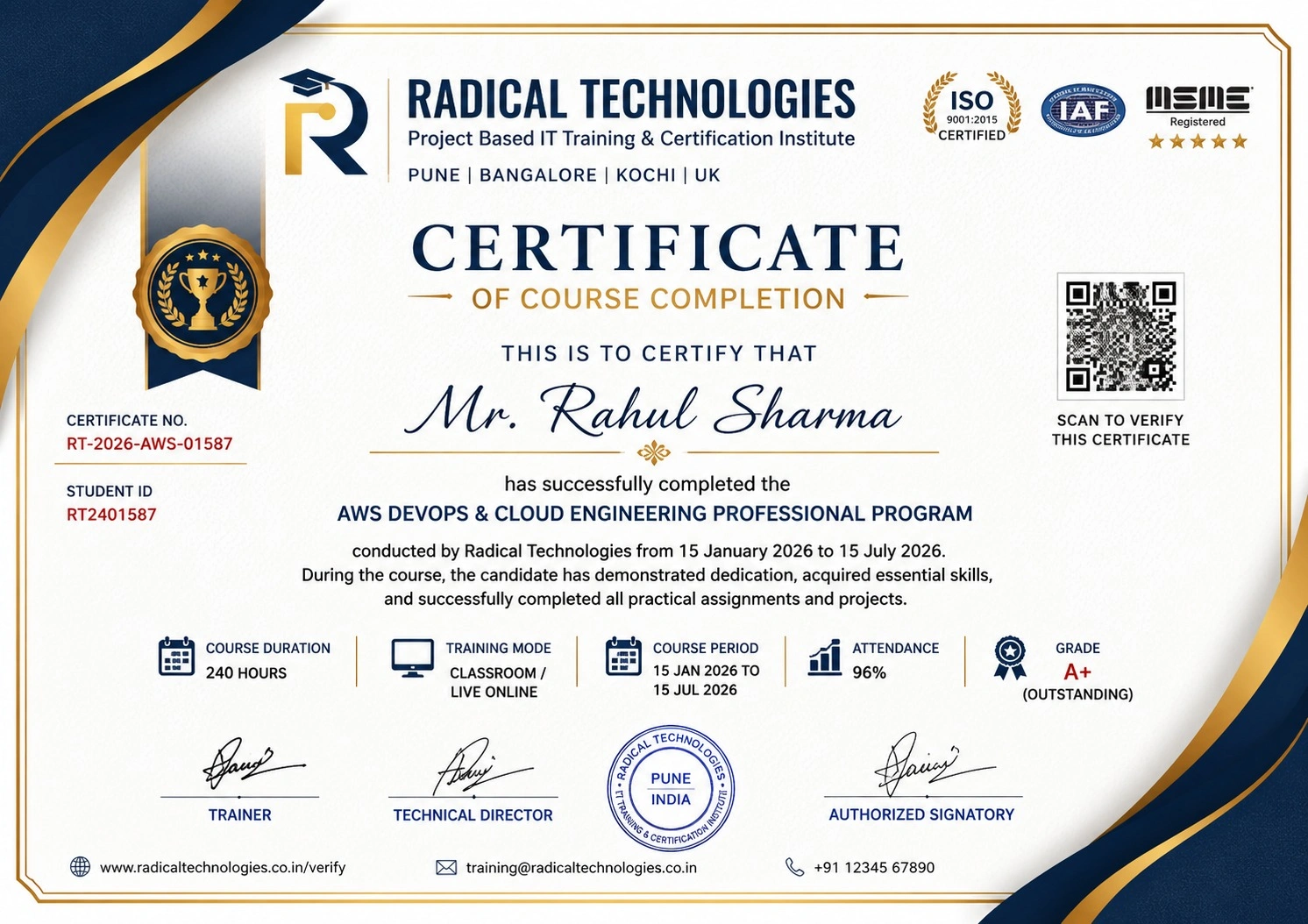
Certificate of Completion

Career Services

At Radical Technologies, we are committed to your success beyond the classroom. Our 100% Job Assistance program ensures that you are not only equipped with industry-relevant skills but also guided through the job placement process. With personalised resume building, interview preparation, and access to our extensive network of hiring partners, we help you take the next step confidently into your IT career.

Career Support

Course Completed? Need next steps?
Need Interview Supports?
Need Job Assistance?
Came from any other Institute?

Join our Brush-up Session & get support until you find a job!

Get Started

Radical Learning Eco-System

Exam Simulator

Cloud SandBox

Hands-on Cloud Lab

Developer Coding Ground

Student Reviews

4.6★
Average learner rating
50K+
Students trained
30+
Hiring companies alumni work at
100%
Placement assistance
4.6
★★★★★

Course Rating

★★★★★
73%
★★★★☆
19%
★★★☆☆
5%
★★☆☆☆
2%
★☆☆☆☆
1%

Course Certification With Training In Pune

Oracle Accounting Hub Training is a 40-hour, basic-to-advanced, practical and job-oriented course designed to help learners understand centralized accounting, Subledger Accounting (SLA), accounting rules, integrations, journal entries, reporting, and reconciliation. Learn how to transform transaction data from Oracle and non-Oracle systems into standardized accounting entries and gain practical knowledge for real-world implementation and support scenarios. Ideal for Oracle Finance professionals, accounting professionals, functional consultants, and IT professionals looking to build Oracle Accounting Hub skills.

Our Alumni Work At
Accenture
Amazon
Avisys Services
Birlasoft
Capgemini
Catchpoint
Cognizant
Darwish Cybertech
DataVision
GiBots
Google
Groots Software
HCL Technologies
IBM
Info Gain
Infosys
ITCube Solutions
KPIT
L&T Infotech
Microsoft
Mphasis
mPhatek
Oracle
Quantbit Technologies
Saina Cloud
TCS
Tech Mahindra
Wipro
YASH Technologies
Zensar Technologies
Accenture
Amazon
Avisys Services
Birlasoft
Capgemini
Catchpoint
Cognizant
Darwish Cybertech
DataVision
GiBots
Google
Groots Software
HCL Technologies
IBM
Info Gain
Infosys
ITCube Solutions
KPIT
L&T Infotech
Microsoft
Mphasis
mPhatek
Oracle
Quantbit Technologies
Saina Cloud
TCS
Tech Mahindra
Wipro
YASH Technologies
Zensar Technologies

Get a Call Back from Our Career Assistance Team

Request Callback